Thinking about celebrating Day of the Dead in a unique way? How about Quito, Ecuador.
The capital, also known as the Middle of the World, not only has the largest and best preserved historic center in America, but it also has one of the richest cultures in the continent and Day of the Dead or Dia de los Difuntos is no exception.
Every November 2, cemeteries are decorated with flowers, freshly painted crosses, pictures and cards to celebrate the Day of the Dead in Quito.
Early in the morning, thousands of Ecuadorians remember their family members and friends who’ve passed away with prayers, vigils and songs. This popular holiday merges hundreds of years of traditions in a fusion of Catholic and indigenous rites, where faith and religion come to life in an act of profound significance.
The oldest towns in Ecuador have been celebrating the dead since before the arrival of the Spaniards, but with Christianity, the tradition was adapted to the Catholic calendar. Today, the streets near the cemeteries fill with locals selling flowers and prayer cards and food trucks providing typical cuisine such as colada morada and guaguas de pan, which represent the religious syncretism and culinary fusion of the holiday. At the Calderon Cemetery, about 30 minutes from Quito, indigenous communities visit the graves of their loved ones and share the favorite food of the person who passed away as a way to honor them and communicate with them, with the belief that the deceased live a similar life than the one they lived while alive.
The preparation of these dishes also serve as a reason for the entire family to get together. Colada morada, one of the typical beverages for the Day of the Dead, is a drink of indigenous origin and one of the most traditional delicacies of Quito’s cuisine. Prepared with a base of black corn, blueberries, blackberries, pineapple, orange and other fruits and herbs, colada morada is accompanied by the traditional guagua de pan, sweet breads shaped into baby-like figures made with wheat flour and, in some places, with cornmeal from grains from the Ecuadorian Andes.
The guaguas de pan are reminiscent of the dead, especially children (hence the name guagua, which means child in Quechua). Its origin dates back to the nineteenth century and today are normally filled with guava, figs, chocolate, raisins and custard or tree tomato. For the Silo, Luciana Soula.
Performance and elegance meet in the new ATH-AWX7000, Audio-Technica’s finest headphones ever
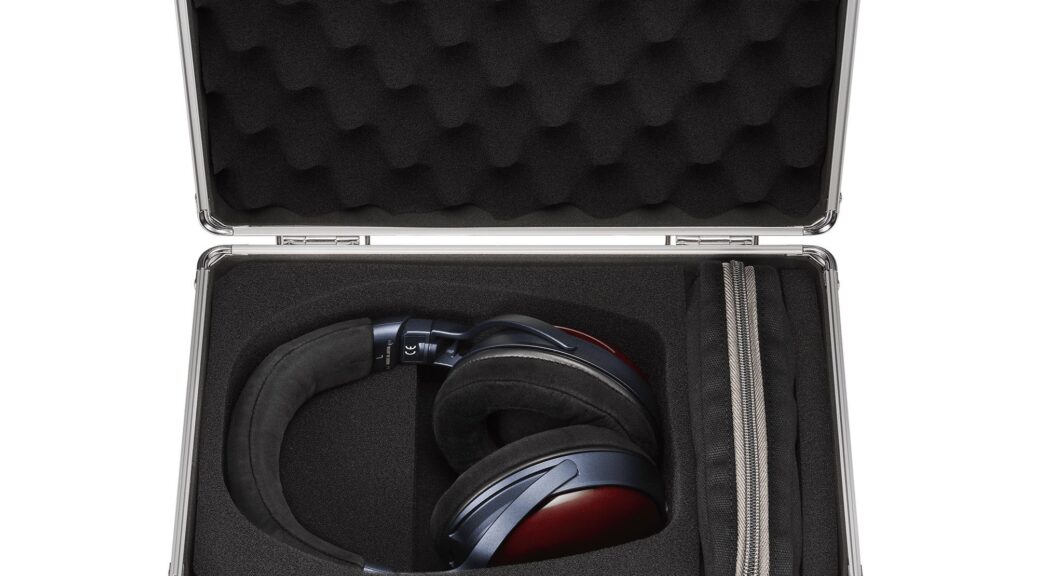
Stow, OH, October 2026 — Audio-Technica announces the introduction of its ATH-AWX7000 Closed Back Dynamic Wooden Headphones, combining ultimate audio performance with exquisite Japanese wood craftsmanship to create the company’s finest headphones ever. The new ATH-AWX7000 features newly developed HMD (Hybrid Matrix Diaphragm) technology along with additional advancements and sets an extraordinary new sonic standard in audiophile dynamic headphones.
The housings of the ATH-AWX7000 are crafted from Kiso cypress, a prized wood used to construct Shinto shrines and Buddhist temples. The wood is hand-finished in traditional Echizen lacquer to bring out the natural color of the wood’s grain. Over time, the color will darken, to add to the wood’s beauty and distinctive character. The headphones’ frame and other components are finished in the traditional Japanese deep navy hue of kachi-iro (the traditional lucky color of the samurai).
The lightweight magnesium frame features aluminum sliders that allow precise size adjustments, and deerskin is used for the earpads and headband for superior comfort and sound isolation. Like all Audio-Technica wooden headphones, the ATH-AWX7000 is manufactured in Tokyo, Japan, to the absolute highest standards.
Size matters- 58mm Diaphragm
Audio-Technica’s newly-developed HMD Hybrid Matrix Diaphragm employs a composite material made from polymer film and a metal dome. It is manufactured using the company’s HXDT molding process, which produces a large-diameter 58mm diaphragm that can be aligned with the driver’s high-efficiency magnet structure, voice coil and other components with extreme accuracy.
The HMD technology enables the composite diaphragm to maintain its shape even under high air pressure. By driving the air with a more precise pistonic motion even below the audible range, the result is a level of bass power and musical accuracy previously unattainable in other closed-back designs, with extraordinary sonic purity, resolution and dynamic impact. The sound is warm and lush, immersing the listener in an inviting musical expanse.
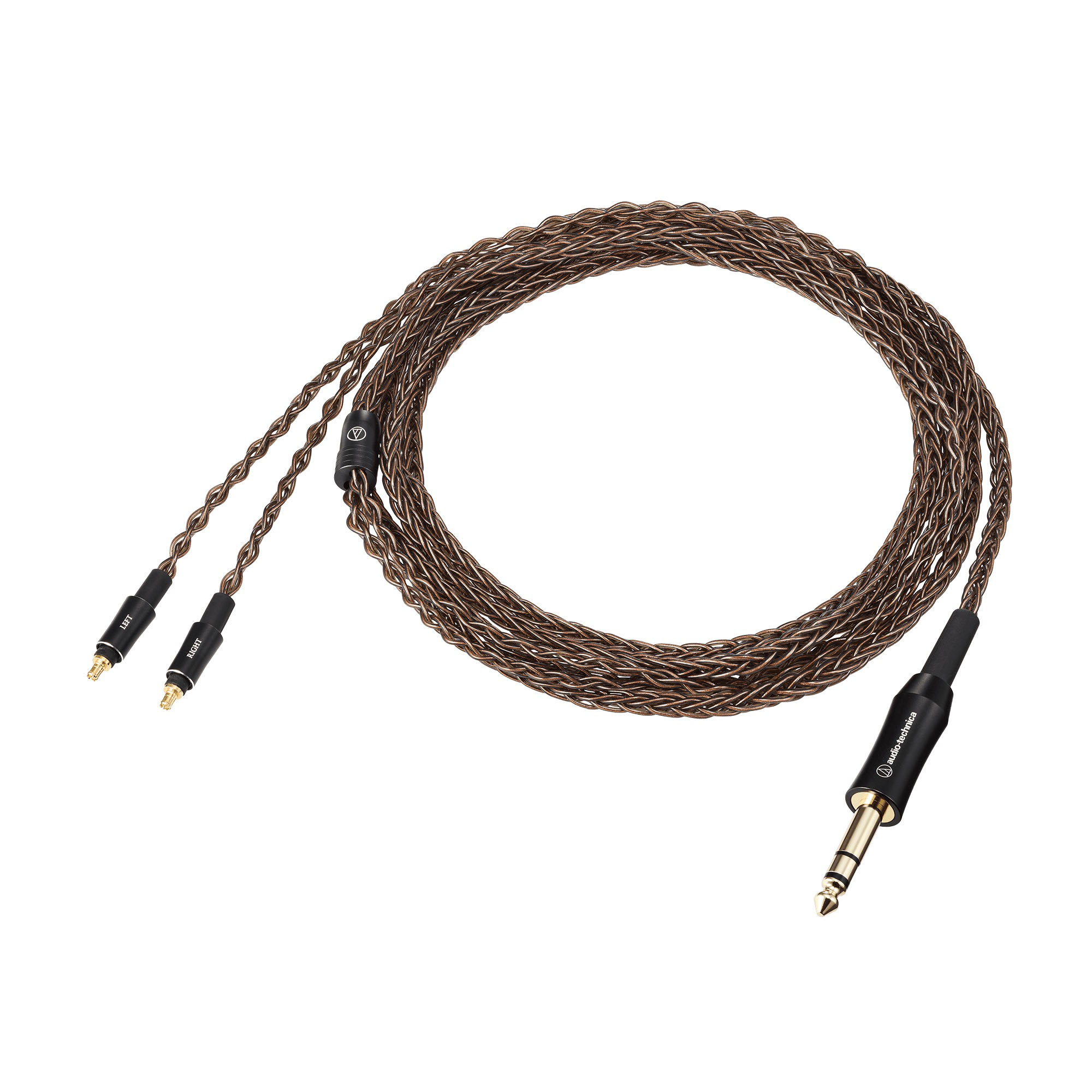
Braided cable included with Audio-Technica ATH-AWX7000 Closed Back Dynamic Wooden Headphones.
Detachable braided Cabling
The ATH-AWX7000 comes with two detachable 8-braid cables with Audio-Technica’s A2DC (Audio Designed Detachable Coaxial) connectors: a balanced 8-foot 2-inch (2.5 m) cable with a 4-pin Neutrik connector, and a 9-foot 8-inch (3.0 m) unbalanced cable with a 0.25-inch (6.3mm) plug. Each ATH-AWX7000 comes with a compact carrying case.
The Audio-Technica ATH-AWX7000 Closed Back Dynamic Wooden Headphones are now available at a suggested US retail price of $3,799.
Audio-Technica ATH-AWX7000 Closed Back Dynamic Wooden Headphones
Audio-Technica was founded in 1962 with the mission of producing high-quality audio for everyone. As we have grown to design critically acclaimed headphones, turntables and microphones, we have retained the belief that great audio should not be enjoyed only by the select few, but accessible to all. Building upon our analog heritage, we work to expand the limits of audio technology, pursuing an ever-changing purity of sound that creates connections and enriches lives.
For the Silo, Frank Doris.
— For more information on the complete range of Audio-Technica products, contact Jamie Bobek, Audio-Technica U.S., Inc., 1221 Commerce Drive, Stow, OH 44224. Tel: (330) 686-2600; Fax: (330) 688-3752.
Please mention The Silo when contacting.
— For further information regarding product availability and pricing in Europe, contact Amelia Reckordt (areckordt@audio-technica.eu).
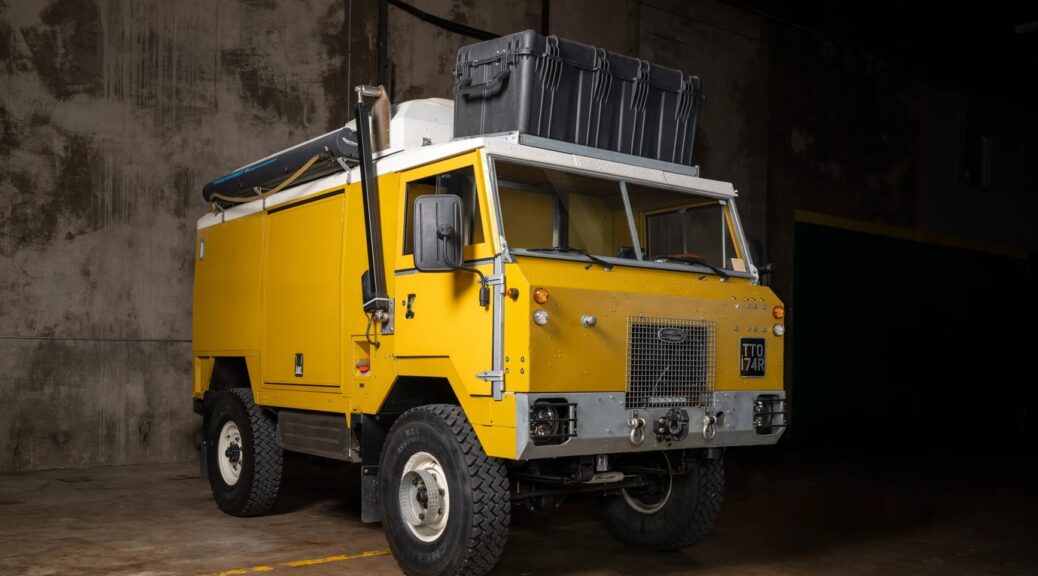
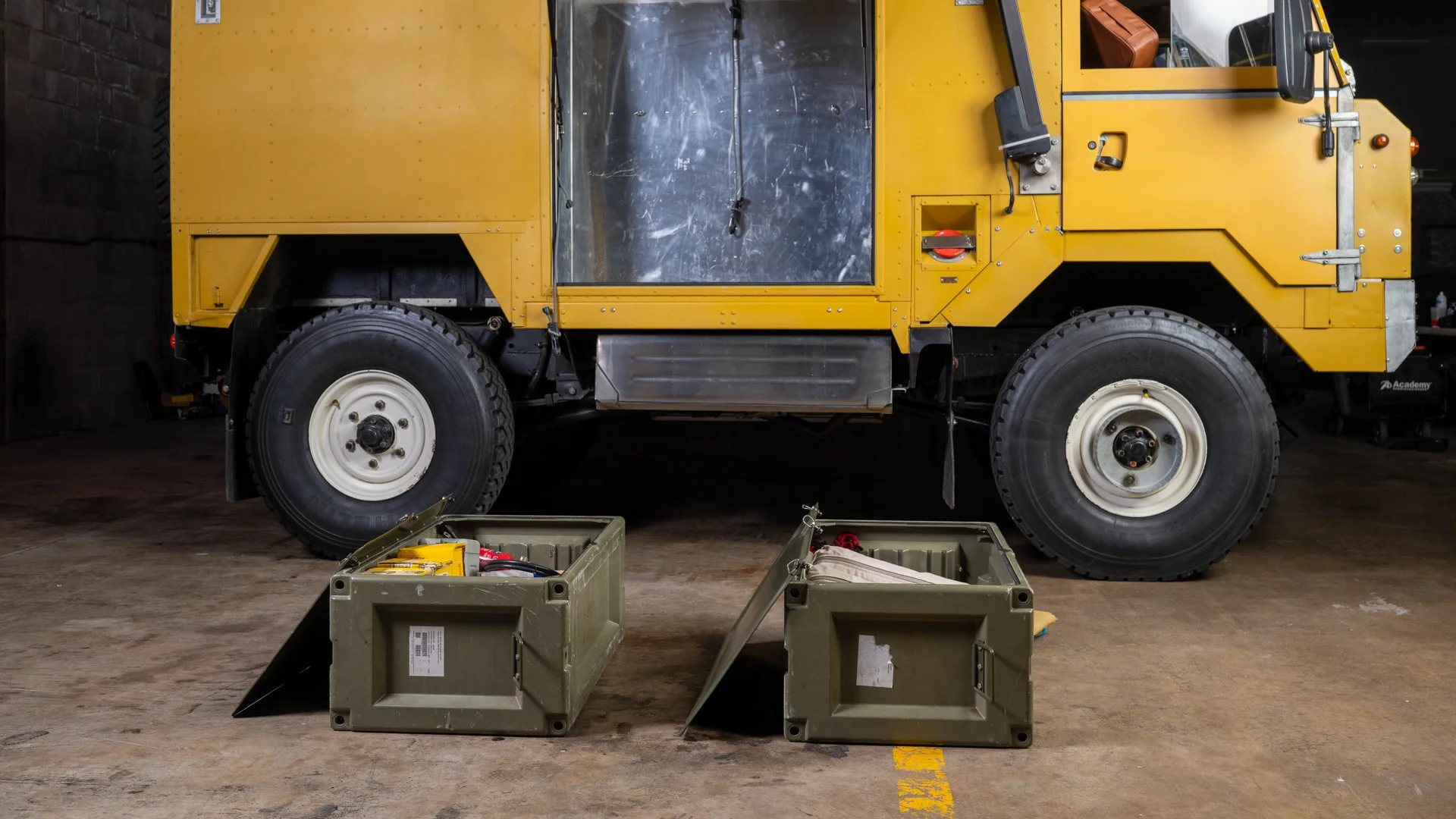
From the Driven Eclectic Collection- 1977 Land Rover 101 Forward Control “Survival Truck”
If you have ever imagined yourself (and your +1’s) safely managing a Zombie apocalypse and driving from a danger to a safe zone- this is the vehicle you want to be in.
Offered for sale in the Las Vegas auction via Broad Arrow Auctions from The Driven Eclectic Collection
An ex-U.K. Ministry of Defence (MOD) surplus truck converted into an all-terrain adventure camper
Exceptionally equipped with solar power, an AluCab 270-degree awning, and full living quarters with a kitchenette
Supplied with a Ministry of Defence Certificate of Origin and period MOD inspection reports
Powered by a replacement 3.5-liter Rover V8 coupled with an LT95 four-speed manual transmission complete with a dual-range transfer case and vacuum-locking center differential
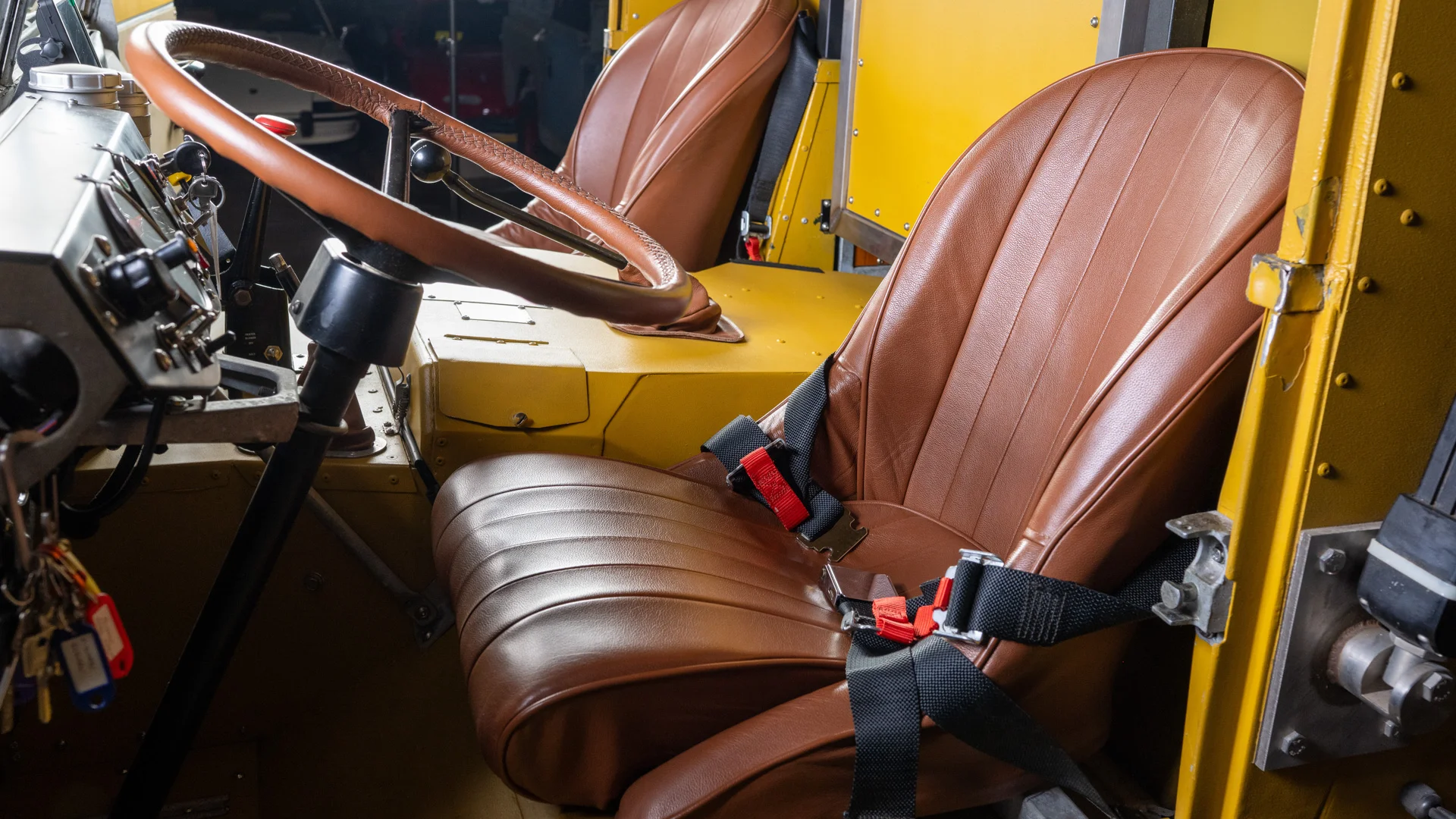
Presented in Davos White with Bahama Gold Raptor bedliner over brown leather upholstery
Left-hand-drive example with prior ownership in Poland and the U.K.; imported to the U.S. in 2023
Chassis No. 96400307
The Land Rover 101 Forward Control was a rugged but lightweight forward utility vehicle in use by the British Armed Forces in the 1970s.
Although primarily created as a compact artillery gun tractor, the dynamic design of the Land Rover 101 expanded its use across a wide variety of roles such as radio command center, electronic warfare vehicle, ambulance, and even as a surface-to-air missile platform. Though retired from service by the late 1990s, the surplus stock of some 2,700 Land Rover 101s have since become a popular platform for enthusiasts to create their dream offroad vehicle.
Built in October 1976, this left-hand-drive 1977 Land Rover 101 Forward Control was originally dispatched to the Central Army Vehicle Depot in Ashchurch, England according to its British Heritage Trust Certificate. Its accompanying Certificate of Origin from the British Ministry of Defence (MOD) reveals that the truck officially entered service on 1 January 1977, and remained active until 27 November 1992 when it was purchased from MOD through the Disposal Sales Depot. First officially road registered in the U.K. in October 1997, prior research indicates that the Land Rover may have spent several years in a Polish collection before returning to the U.K. in July 2018.
The ex-military Land Rover has since been painstakingly transformed into an overland-style camper prepared for any terrain.
It is armed with an arsenal of camping gear, headlined by an Alu-Cab 270-degree awning and Pop-Top sleeping system with Sauleda acrylic canvas tent, hinged raising bed platform, and memory foam mattress. Its exhaustive list of adventuring upgrades is further underscored by LED exterior lighting, generous exterior storage, a portable shower, and a detailed auxiliary power system that includes a Cotek 3.5 kW inverter and two roof-mounted 100W solar panels with Victron Energy super cycle 125ah batteries.
The original military-issue Bronze Green paint was replaced with Davos White and Bahamas Gold Raptor bedliner. Inside, the Land Rover features detailed living quarters complete with a rear kitchenette with propane stove, sink, and SnoMaster refrigerator. The cabin floors and ample storage compartments are made from teak, while the seats are trimmed in BOXMARK XTREME water-resistant brown leather and the headliner is made from British Millerain weather-resistant canvas. The interior is also furnished with Monitor Audio Climate 50 speakers married to dual Mission Cyrus 2 amplifiers with Bluetooth capability, a television mount, and even a backup camera. All-weather essentials include a Webasto gas heater, 60-liter stainless water tanks with electric pump, and Lifeline water filtration.
The Land Rover is reportedly powered by a replacement 3.5-liter Rover V8 featuring rebuilt dual Stromberg carburetors and a host of supporting modifications including an aluminum radiator and stainless steel exhaust. This is managed by a rebuilt LT95 four-speed manual transmission with dual-range transfer case and vacuum locking center differential. Additional equipment includes adjustable air ride suspension complete with Bilstein shocks, 16-inch steel wheels shod in Michelin XZL all-terrain tires, and Able Engineering disc brakes on all four corners.
Prior research indicates that much of the camper conversion was performed by Latitude Overland in Bristol, U.K., while the Land Rover’s electrical overhaul was completed by R&L Auto Electrics in Plymouth. Acquired by the consignor in August 2022, the Land Rover was subsequently imported to the U.S. at the beginning of 2023 and shipped to Austin, Texas; entering a remarkable collection of rare automobiles.
This 1977 Land Rover 101 Forward Control is offered today with an extensive history file that includes its Certificate of Origin from the Ministry of Defence, multiple military inspection reports during its service period, and prior U.K. registration.
Outfitted with an extensive array of thoughtful upgrades inside and out, this example is equipped to venture far beyond the beaten path. Whether embarking on a challenging overlanding expedition or enjoying a memorable off-grid escape at a favorite campsite, it offers a unique but well-equipped platform for the adventures its next caretaker dreams to set out on.
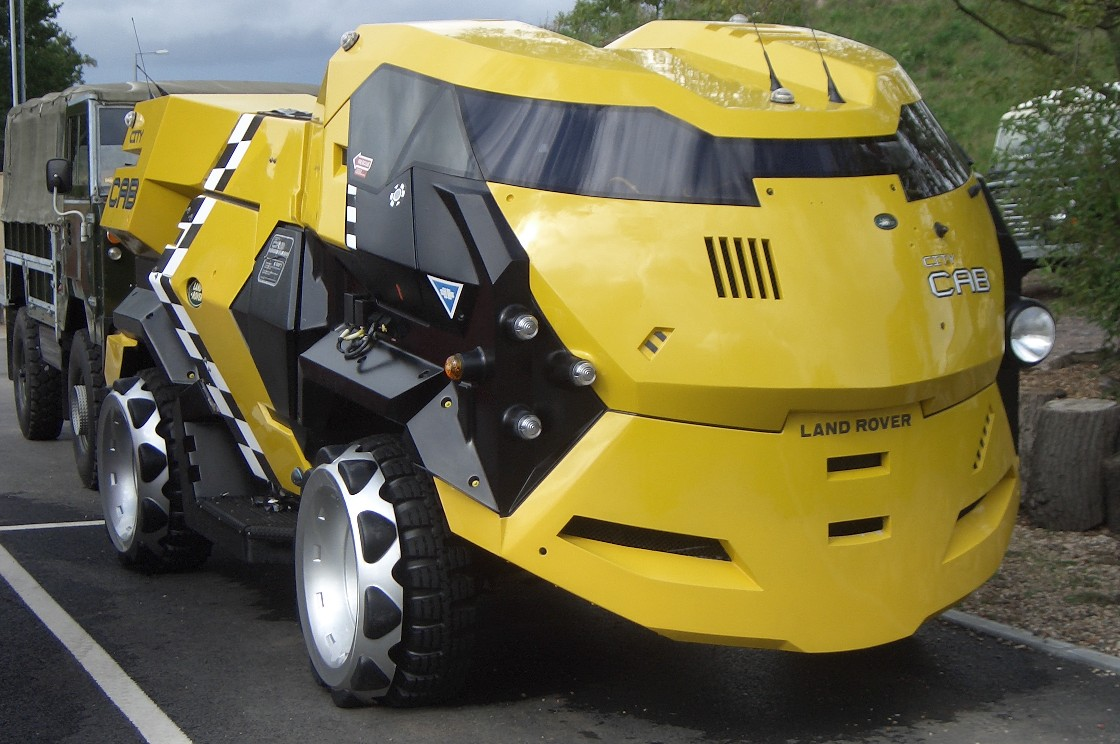
Thirty-one 101s were converted by Land Rover with styled bodyshells for the 1995 Sylvester Stallone film Judge Dredd. Land Rover is supposedly the world’s only surviving ground vehicle manufacturer in 2139 when the film is set, and the green oval logo can be seen on the side of the vehicles, known as “City CABs” talkingpix.com
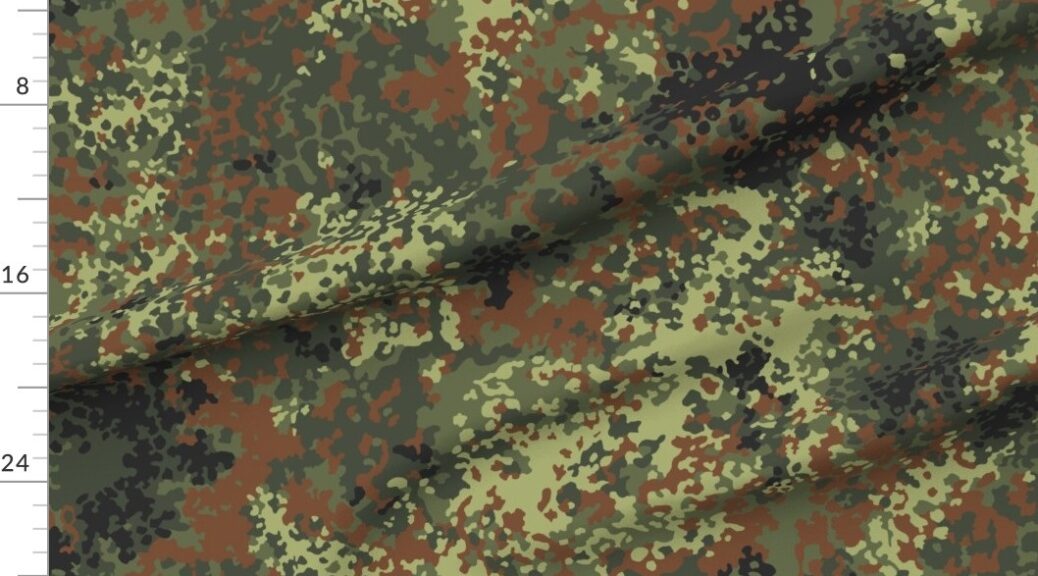
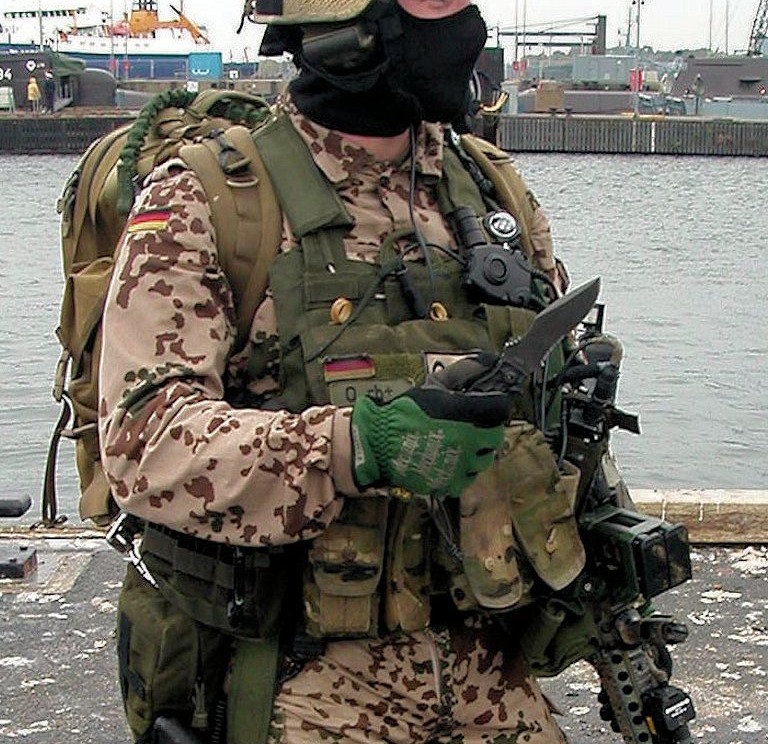
Flecktarn is one of the most ubiquitous camouflage patterns in every military surplus enthusiast’s closet and I bet many of you guys and gals already own some. But every now and then, our friends at Kommandostore get in something arguably even more special: Flecktarn’s tropical cousin Tropentarn. Wait…what? What the heck are Germans doing making a desert camo?
via ufpro.com– Just like M81 Woodland and DPM, 5FT Flecktarn decisively influenced the development of other camouflage patterns and their adaptation by other countries. One might say these three patterns inspired the next generation of camouflage patterns, much as the three were inspired by the WW2 patterns that preceded them. Accordingly, several countries merit mention:
The People’s Republic of China outfitted its Border Defence Units with an unlicensed copy of Flecktarn. Also, utilized in Tibet and the Beijing Military Region was a recolored, brown-dominant variation (which is highly sought-after by collectors).
Belgium interpreted German 5FT Flecktarn in a variant that was worn by its Airbase Security Personnel until 2000.
Denmark developed a green-dominant variation using only three instead of five colors. Tested in 1978, it today calls attention to the close cooperation of textile companies back then, since it is rumored to have been jointly developed with the French company Texunion.
The Netherlands briefly considered fielding Flecktarn as a camouflage pattern, but for political reasons decided against it (Dutch decision-makers felt there was too close a resemblance to the patterns used by the SS during the Second World War).
Japan created its own Flecktarn version and in 1991 fielded it within the JNSDF.
And before you go and say- “Hey buddy, the Germans have had a bit of a history fighting in the desert”, Tropentarn comes from trials after the successful implementation of Flecktarn. Good ol ‘Fleck had a bit of a hard time getting fully fielded as Germany was a bit sensitive to using any kind of pattern that resembled the various Waffen SS experiments in the 40s for obvious reasons. This was back in the late 70s after all.
But after ‘fleck got through the filter, Germany’s increased presence as peacekeeping forces brought them to the doorstep of everyone’s favorite sandbox, the middle east. A new camo was needed. As early as ’93, Tropentarn would appear as a reduced 3-color (vs 5 colors in normal flecktarn) arid version of the now beloved pattern. Unlike many desert patterns of the era, the Germans tastefully sprinkled in a few specs of green to really make the camo versatile beyond the dunes in Iraq.
If you’re not aroused by the typical brown, brown and more brown nature of a lot of desert camos, Tropentarn might be the right one for you. It even has a few bonus features over the normal field shirt that make it a little more breathable in the summer if you live in the south or simply yearn for temperatures over 70 Fahrenheit in polar vortexes like today’s…
It even works wonders in the great plains since everything turns tan come the wintertime and it gets just as much attention from fellow milsurp enjoyers and normies alike. So if you’re in the mood for another flavor of flecktarn in your wardrobe you’ll definitely want to dive in and grab one on the kommandostore site while you can, they’re always popular…and stock won’t last long. For the Silo, Jarrod Barker.
Featured image- Erbsentarn 44 dot peas pattern German WW2 Waffen SS standard camouflage pattern.
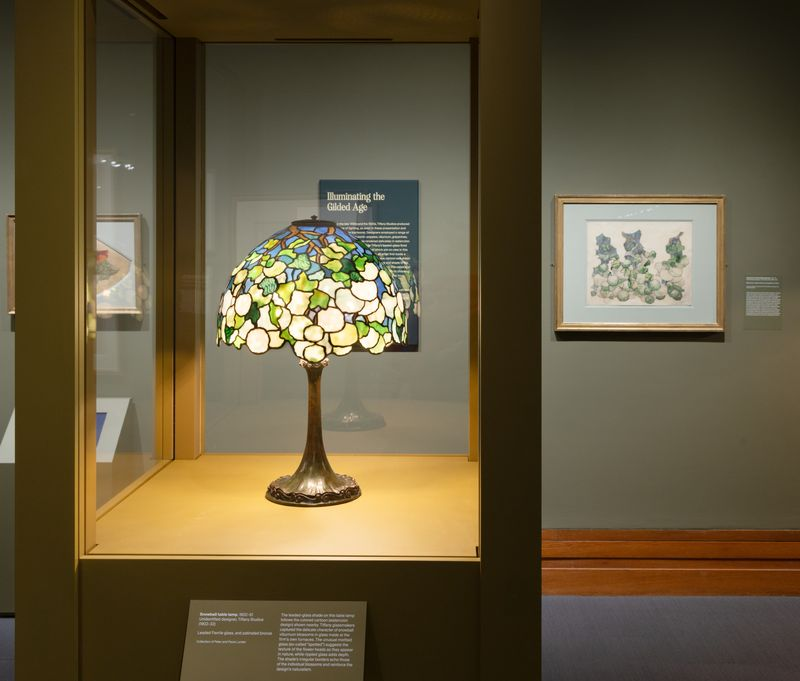
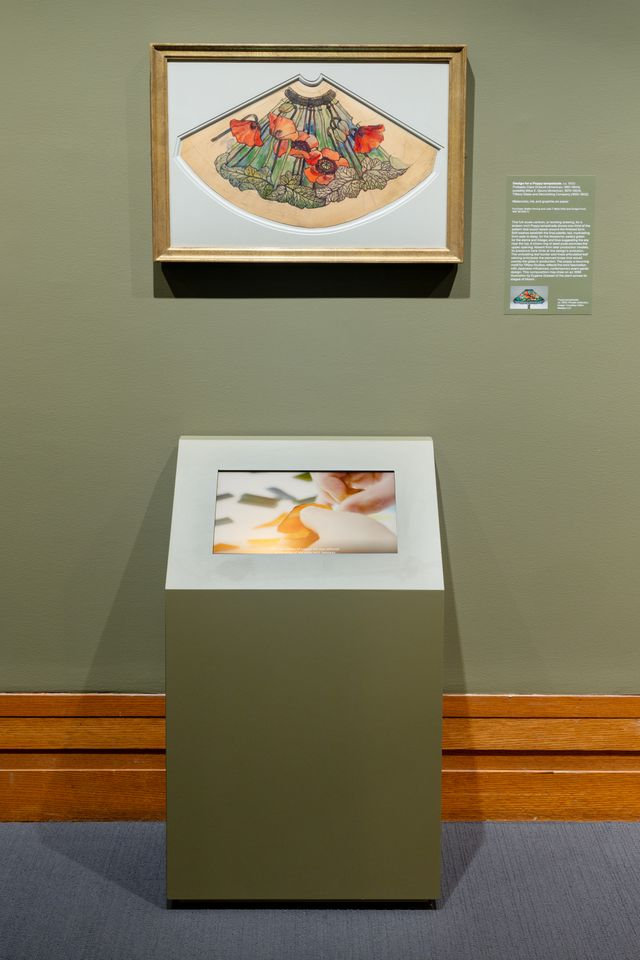
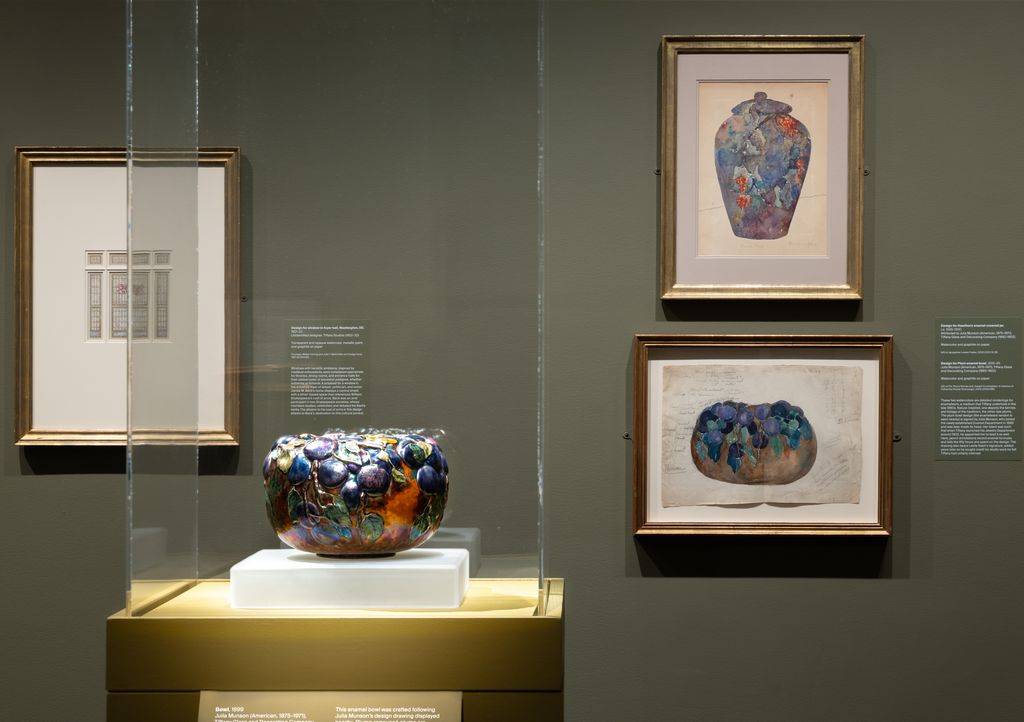
The Met to Present the First Major Exhibition Dedicated to the Design Drawings for Louis C. Tiffany’s Celebrated Gilded Age Creations
Newly conserved works reveal the creative process behind Tiffany Studios’most celebrated stained-glass windows, lamps, mosaics,and interiors.
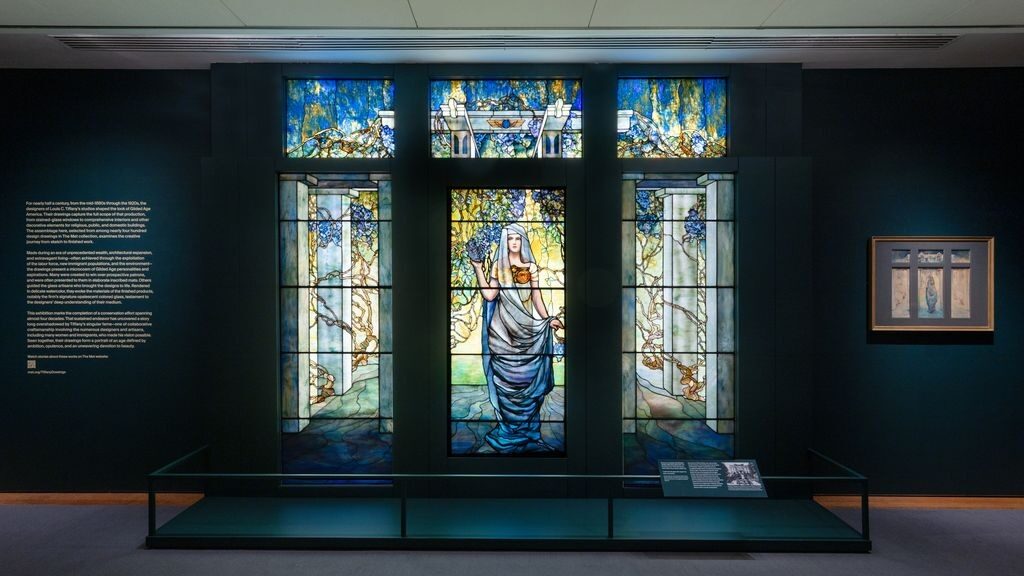
This exhibition will reunite two major stained-glass windows with their original design drawings for the first time in nearly half a century—This fall, The Metropolitan Museum of Art will present Designing the Gilded Age: Drawings from the Studios of Louis C. Tiffany, a major exhibition exploring the creative process behind some of Tiffany Studios’ most celebrated works.
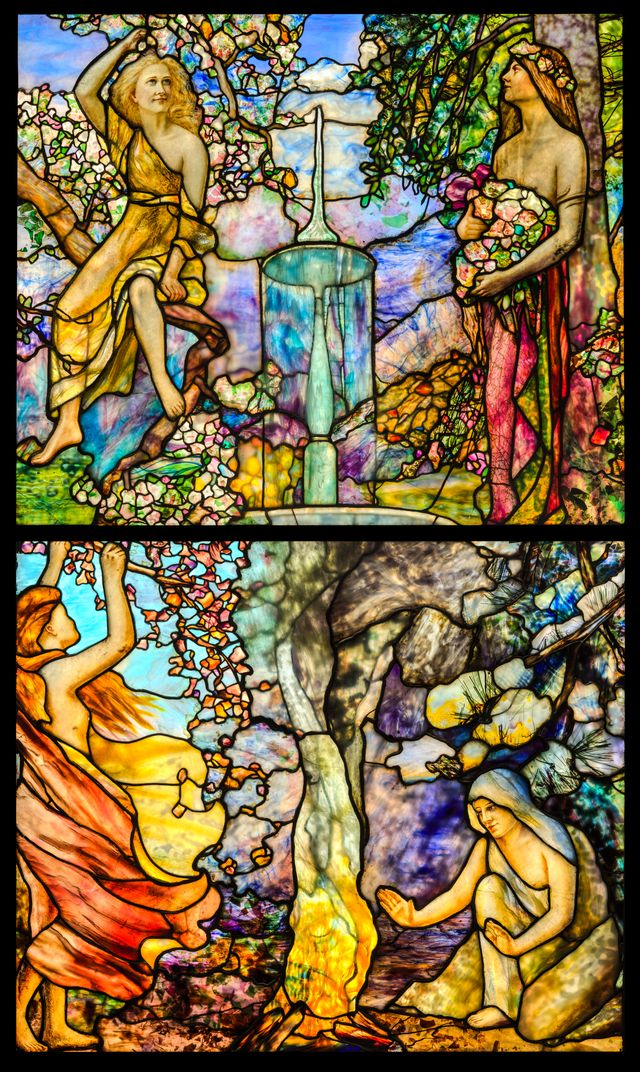
Four Seasons in Glass
On view from October 22, 2026, through February 7, 2027, the exhibition brings together nearly 120 works from the Museum’s collection—along with a select group of key loans—to examine the artistic range of Louis Comfort Tiffany and the collaborative studio that produced significant works of American decorative art.
A major loan from the Chrysler Museum of Art reunites its monumental stained-glass window, Woman in a Pergola with Wisteria(1911), with the original wisteria transoms designed for the work. Recently discovered in a private home in Arizona, the transoms make possible the ensemble’s first presentation together in at least half a century.
The exhibition is made possible by Tiffany & Co. “The Met’s unparalleled collection of design drawings from the studios of Louis C. Tiffany reveals how some of the most iconic works of American decorative art came to life,” said Max Hollein, The Met’s Marina Kellen French Director and Chief Executive Officer.
“The exhibition illuminates the artistry, innovation, and collaboration at the heartof Tiffany studios, while offering new insights into the cultural and aesthetic ambitions of the Gilded Age.”
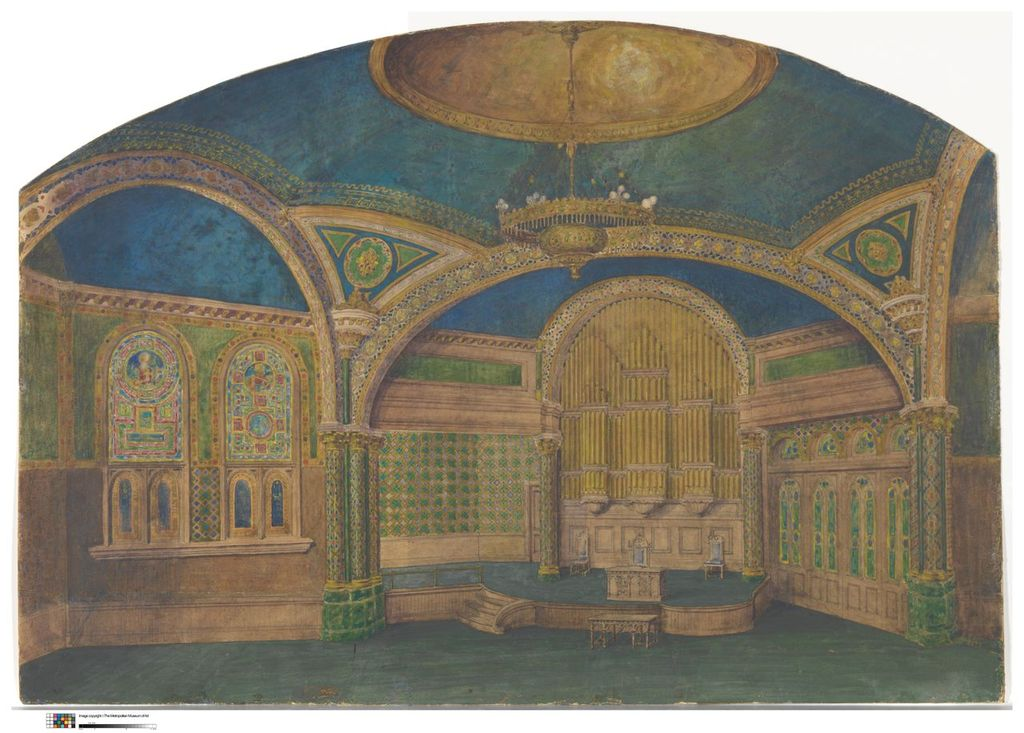
Design for interior of First Presbyterian Church.
Largest Collection Of Tiffany Drawings In The World
“This exhibition builds on decades of conservation and sustained study of The Met’s extraordinary holdings—the largest collection of Tiffany design drawing s anywhere,” said Alice Cooney Frelinghuysen, The Met’s Anthony W. and Lulu C. Wang Curator of American Decorative Arts.
“As these works have been conserved to their full beauty, they reveal the richness and complexity of the studio’s creative process. The reunion of two major windows side by side.
The exhibition allows visitors to see the transformation of an idea into a luminous work of art.
Spanning the early 1890s through the 1920s, Designing the Gilded Age: Drawings from the Studios of Louis C. Tiffany also highlights the extraordinary breadth and ambition from the studios of Louis C. Tiffany, from stained-glass windows and lamps to mosaics, enamels, textiles, and interiors created for private homes, houses of worship, theaters, and public buildings during America’s Gilded Age. These rarely seen works on paper—from quick working sketches to luminous watercolor presentation drawings—offer an unprecedented behind-the-scenes view of the collaborative artistic process that shaped the studios of Louis C. Tiffany commissions across the United States as well as in Canada, Mexico, Cuba, and Switzerland.
Many of the drawings on view document works that have since been lost, altered, or never realized, offering invaluable information about Louis C. Tiffany’s artistic vision and the breadth of his studio’s output. Organized thematically across three galleries, the exhibition explores designs for domestic interiors, ecclesiastical settings, and public and commercial commissions alongside Tiffany’s pioneering work in lighting.
Select loans—including stained-glass windows, lamps, and decorative objects—will be presented in dialogue with their corresponding drawings, allowing visitors to trace the transformation from concept to finished work. A central focus of the exhibition is the collaborative nature of Tiffany studios, which brought together adiverse group of designers, many of whom were historically uncredited. The presentation will highlight the contributions of not just Tiffany but other key figures, among them émigré and women designers—British-trained Frederick Wilson and Swiss-born Jacob Holzeras well as Agnes Northrop, Clara Driscoll, and Julia Munson—while shedding light on the broader network of artists and artisans whose work shaped Tiffany’s distinctive aesthetic.
In addition, Designing the Gilded Age will examine the conservation of these fragile works on paper, with interpretive materials and digital components revealing the discoveries made through decades of study and preservation. The Gilded Age, a period of unprecedented economic growth in late 19th-and early 20th-century America, produced the major cultural institutions of New York and the nation, including The Metropolitan Museum ofArt, founded in 1870.
Against the backdrop of that formative period, the work of Louis Comfort Tiffany flourished.
Designing the Gilded Age: Drawings from the Studios of Louis C. Tiffany also situates Tiffany’s work within the broader cultural and economic context of this period that was marked by rapid industrial growth and an expanding market for luxury goods. The drawings reveal the role of design in shaping immersive environments—from domestic interiors to sacred and civic spaces across the United States and abroad.
Exhibition Credits
The exhibition is organized by Alice Cooney Frelinghuysen, The Met’s Anthony W. and Lulu C. WangCurator of American Decorative Arts, with Barbara Veith, Research Associate, TheAmerican Wing. A fully illustrated catalogue by Frelinghuysen and other authors, published by The Met, will accompany the exhibition. The catalogue is made possible by the Barrie A. and Deedee Wigmore Foundation. Additional support is provided by the William Cullen Bryant Fellows of The Metropolitan Museum of Art, The Richard Hampton Jenrette Foundation, and Arlie Sulka.
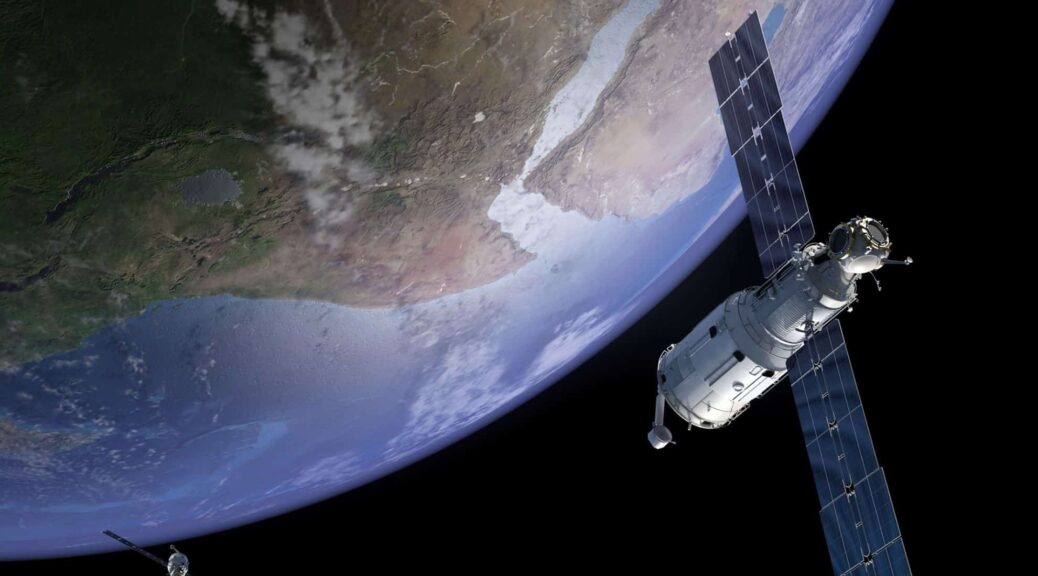
A Russian military satellite is shadowing a radar satellite that Ukraine reportedly relies on, and the distance between them is disputed.
For more than three days, Kosmos 2612 has flown in near-formation with the US satellite ICEYE-X36 used by Ukraine. The operation sets a new precedent in space. Experts worry about escalation as Russia’s goal remains unclear. Plesetsk Cosmodrome, launch site 43/4 for Soyuz-2.1v and Soyuz-2.1b rockets. Satellite image by Planet Labs: 18 October 2026. Analysis by Vertical52.
For three days, one of Russia’s military satellites has been doing something unseen in low Earth orbit: It has pulled up alongside a US commercial satellite at low relative speed and proceeded to stay close. Satellite shadowing manoeuvres are common, but never before has a Russian spy satellite come this close to another state’s space infrastructure for such an extended period of time.Similar operations have proliferated in recent months, as countries seem to prepare for potential conflicts in space. A month ago, the US military confirmed it has deployed weapons in orbit. There is extensive documentation of Chinese satellites shadowing Western space objects or practicing close proximity manoeuvres with their own satellites.
In July, The Insider and Der Spiegel reported on a Chinese-Russian plan to limit or destroy SpaceX Starlink infrastructure. This recent operation targets the satellite ICEYE-X36, registered in the US and providing radar data to Ukraine.
How close was the Russian satellite? Thursday 15 October, Axios reported that Russia’s Kosmos 2612 was detected more than 320 kilometres from ICEYE-X36. By Friday afternoon, their distance was about 5 kilometres – close proximity for objects moving at many kilometres per second. The latest orbital data projected that Kosmos 2612 would position itself closest to the US-registered satellite yesterday afternoon. Proximity estimation by Cosmos Radar, as of 1.11pm UTC. Source: Cosmos Radar.
The analysis portal Cosmos Radar estimates a proximity of just 26 meters. Jonathan McDowell, a satellite tracking expert consulted by Vertical52, could not confirm the number: “With open-source data we can only confidently determine distance within an error margin of up to 2000 meters”, said the astronomer and astrophysicist. Distance calculations by satellite tracking expert Marco Langbroeck. Source; X.
McDowell described the operation as unprecedented and the closest uninvited rendezvous they had observed in Low Earth Orbit. Though earlier Kosmos satellites stalked US satellites too, they stayed at a distance of tens and hundreds of kilometers. “This is different. This is close, low velocity, low orbit. They’ve matched orbits”, said the astrophysicist.
Yesterday afternoon, the Russian spy satellite was projected to come closer to ICEYE-X36 than any other foreign satellite before. Kosmos 2612 was launched from Plesetsk in April alongside other military satellites. Since then, it has orbited in close proximity to ICEYE-X36 and other satellites of the same programme. The operation seems to have been in the making for months. In May, several of them shifted the tilt of their orbits into ICEYE-X36’s orbital plane. They then passed by it at 13 to 18 kilometers, according to analysis by Integrity ISR reported by Meduza.
The US Space Force described the incident in May: “Russia executed fuel-intensive orbital manoeuvres to position four military satellites (Cosmos 2610 through 2613) close to a Western commercial radar satellite used by Ukraine for imagery intelligence.” Over the summer, there were no other noticeable manoeuvres by the Kosmos fleet.
Then, on 30 September, a new burn began – “clearly designed to bring the two objects very close and synchronise their orbital periods, orbital altitude, and eccentricity”, wrote Marco Langbroek, a Dutch satellite tracking expert. What is Russia’s goal? The motive behind Russian spy satellites’ escalation in proximity remains unclear. Payloads, the contents a satellite carries to space, are mostly undetectable through open-source data. This leaves room for speculation. The Center for Strategic and International Studies does not rule out on-orbit weapon use, while Langbroek expressed worries about the satellite’s behaviour. Kosmos 2612’s operation is one sign of the hybrid war Russia wages against Ukraine and NATO is spreading into space.
The manoeuvre aligns with leaked documents that plan the destruction of Starlink space infrastructure. In July, The Insider and Der Spiegel reported on a leaked Russian-Chinese military strategy presentation. The documents described a “joint plan to defeat Elon Musk’s Starlink and a weapons development partnership”. Satellite tracker and astrophysicist Jonathan McDowell currently sees no indication of an obliteration of the US-registered satellite: “My interpretation is that this is an inspection mission, studying it, trying to measure characteristics, maybe try jamming the satellite”. It would not make sense to physically attack the satellite at such low speed.
Home Depot Pressed for Answers As New Tip Emerges About Missing Cats
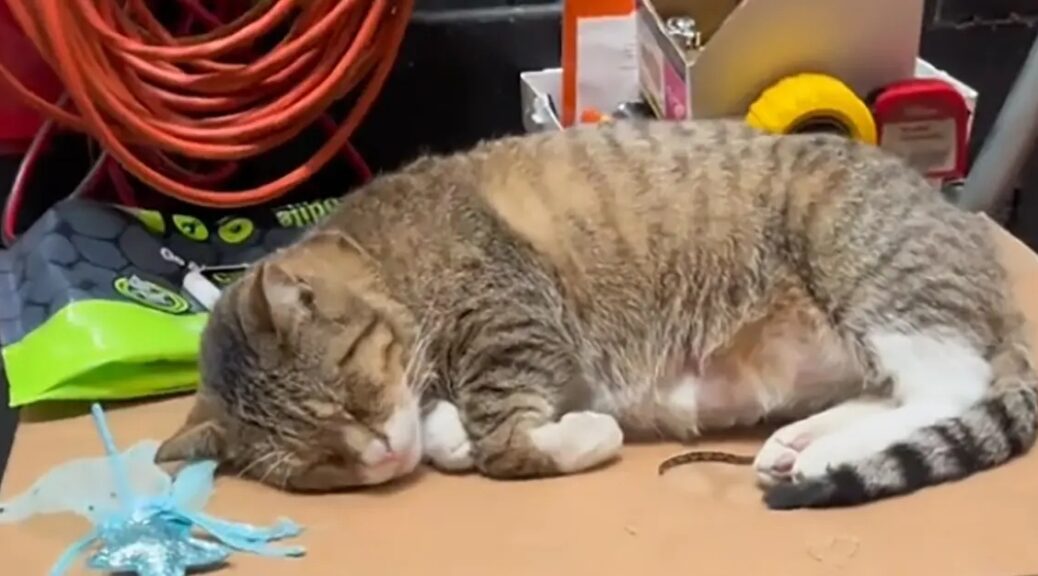
LAKE CITY, Fla. (Oct., 2026) — Community cats Onyx and Sunshine were found dead beside their food bowls at a Lake City Home Depot store in mid-September. Other cats from their colony subsequently disappeared after a contractor began trapping cats at the property. Despite receiving thousands of emails from In Defense of Animals supporters demanding answers, the retail giant has not revealed where the remaining cats are, or what happened to them.
Many Home Depot Stores All Over North America Have “Store Cats”
The Ranch Rescue Fights Back
The Ranch Rescue is an animal welfare group and a community of cat advocates, concerned residents, and animal protection supporters and says it has received a significant tip and is investigating new information about the missing cats. The group is preparing to share its findings publicly.
“They had no voice to cry for justice, so we became their voice. And we will not be silenced,” said The Ranch Rescue founder Laura Rister.
For approximately six years, eight cats lived at Home Depot Store #6864, fed and monitored by a longtime caregiver with the permission of store management. All had been sterilized and vaccinated through a trap-neuter-return program.
Trapping And Removing Cats
In mid-September, the caregiver discovered Onyx and Sunshine dead near their food bowls. the store manager told her she was barred from the property and would be trespassing if she returned, and an outside company began trapping and removing cats, according to The Ranch Rescue and News4JAX.
Four cats — Tortie, Jr., Bentley, and Nikko — remain unaccounted for, according to In Defense of Animals.
The Home Depot has said it uses third-party contractors to humanely capture and relocate animals, but has not publicly identified where the missing cats were taken or provided documention about their fate. The Home Depot did not respond to a request for comment from News4JAX in September. The Ranch Rescue has secured legal representation for the caregiver and continues seeking answers.
Two cats are dead, others have disappeared, and The Home Depot still hasn’t explained what happened to them.
These were living, feeling individuals who were loved and cared for over many years, not disposable objects. Lowe’s went to extraordinary lengths to find one missing store cat, engaging staff and the community to mobilize drones, cameras, and professional trackers to bring her home. Surely The Home Depot can at least account for the cats removed from its property. We’re demanding answers for every cat, and a companywide policy to ensure this never happens again.
In Defense of Animals and Ranch Rescue are calling on The Home Depot to provide a complete, cat-by-cat accounting, including trapping, transportation and veterinary records, and to adopt a humane companywide policy protecting established community cat colonies.
Members of the public can take action now by contacting The Home Depot, posting with #WhereAreTheHomeDepotCats and writing to the company’s leadership.
Farming is in the Chinese DNA — now it has reached orbit.
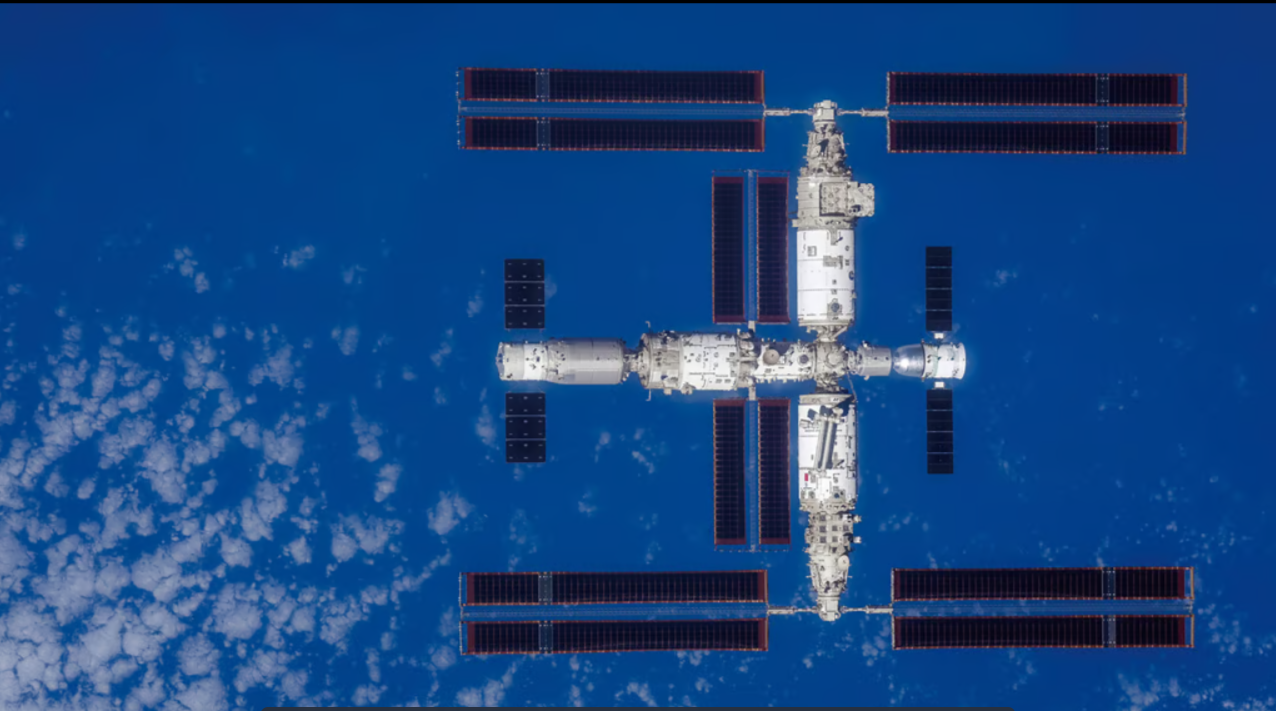
During the Tiangong Class for Hong Kong & Macau students, astronauts live‑streamed their working space vegetable garden, growing fresh leafy greens inside China’s space station.
Many nations have tried planting plants in space, yet China’s full seed‑to‑seed crop experiments push orbital agriculture to a new level. No matter on the ground or hundreds of kilometres out in space, the instinct to grow vegetables never switches off. @Bodenviews
Tiangong Space Station
Most North Americans are aware of the ISS International Space Station but perhaps due to lack of mainstream media coverage (not us though) – much less know about the Chinese Space Station or China’s successful landing on the Moon. The Tiangong is the Space Station that China launched in 2019, with a new Crew and Modules going up every 6 months..
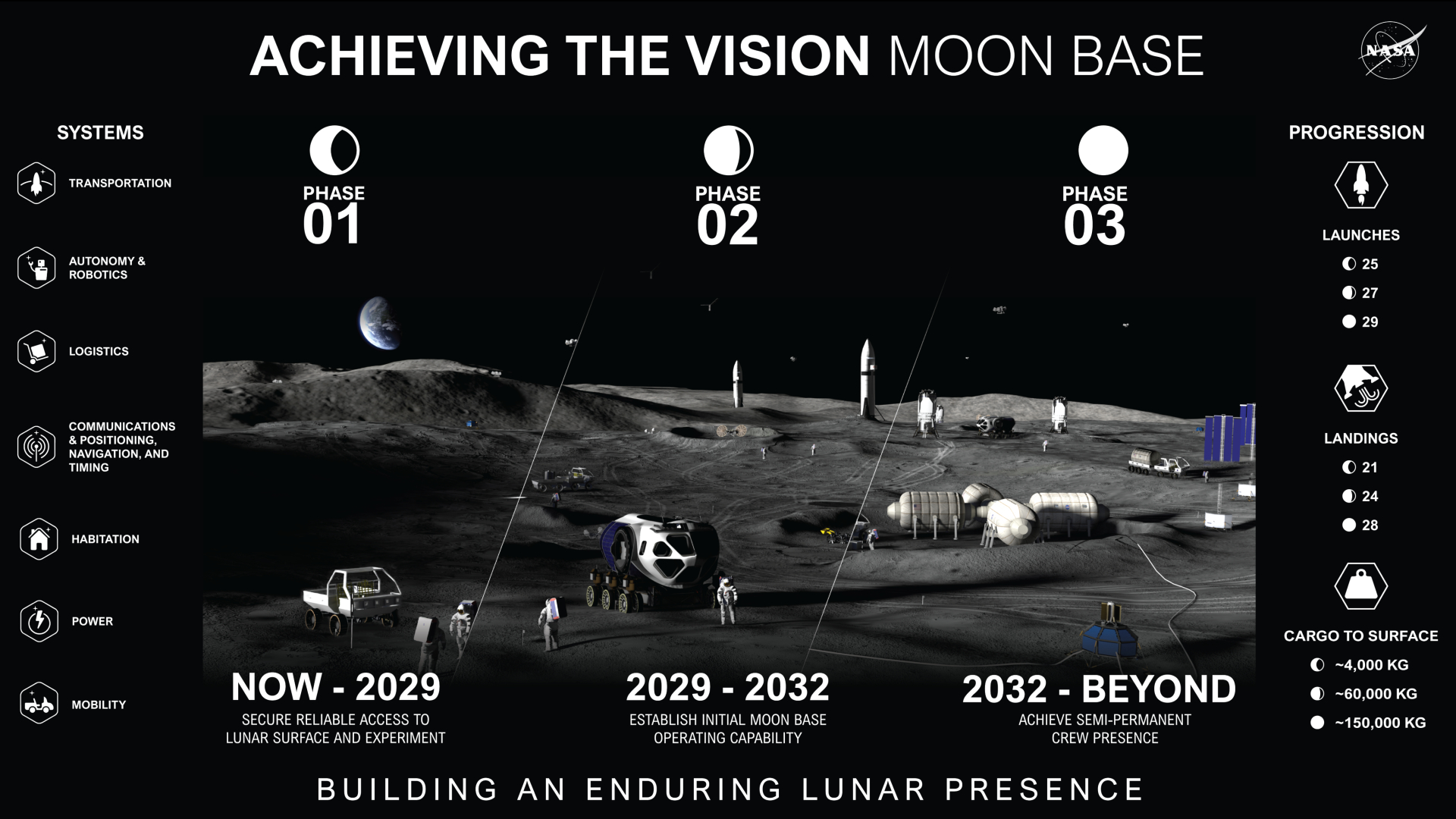
It is now 25% bigger than the ISS, and the plans are to equip it with Fuel Tanks several hundred meters away, to facilitate China’s Moonbase construction by 2030 and in case you missed it, there is a new space race brewing- the return to the Moon for the establishment of a permanent Moonbase.
NASA Project Artemis Timeline towards a Moon base
These are the 1st successful attempts at serious “Gardening” in space, with ‘0’ gravity.
The Tiangong provides regular, daily reports to China, and the World’s Media, but as mentioned above, Western media rarely shows any of the advances that would harm the soon to be decommissioned ISS’s reputation but regularly report on any failings. This sort of “soft censorship” has a common occurrence by all space faring nations- such as the fate of the Soviet Soyuz 11 crew who died upon reentry or the failed launch of the Russian N1 Moon Rocket which exploded in all launches (earthquake tremor machines recorded the explosion and the West deduced what had happened).
Tiangong Facts
The Crew always includes one woman, and the current one- Lai Ka-ying hails from Hong Kong, and speaks both Cantonese and Mandarin.. She is a high school teacher, as have been several Taikonauts before her.
In 1956 the endocrinologist Hans Selye found that stress isn’t just a feeling, it’s a biological event. Your heart rate climbs, adrenaline and cortisol flood your system, and digestion and repair are put on hold.It’s a useful response when you need to give a sharp-toothed predator the swerve. It’s less useful when the predator is just a 3am email or a noisy neighbour.The neuroscientist Bruce McEwen later named the cumulative cost allostatic load, and blood pressure, immunity and sleep all pay it.
Clothing can help you go places, do things or make some kind of statement.
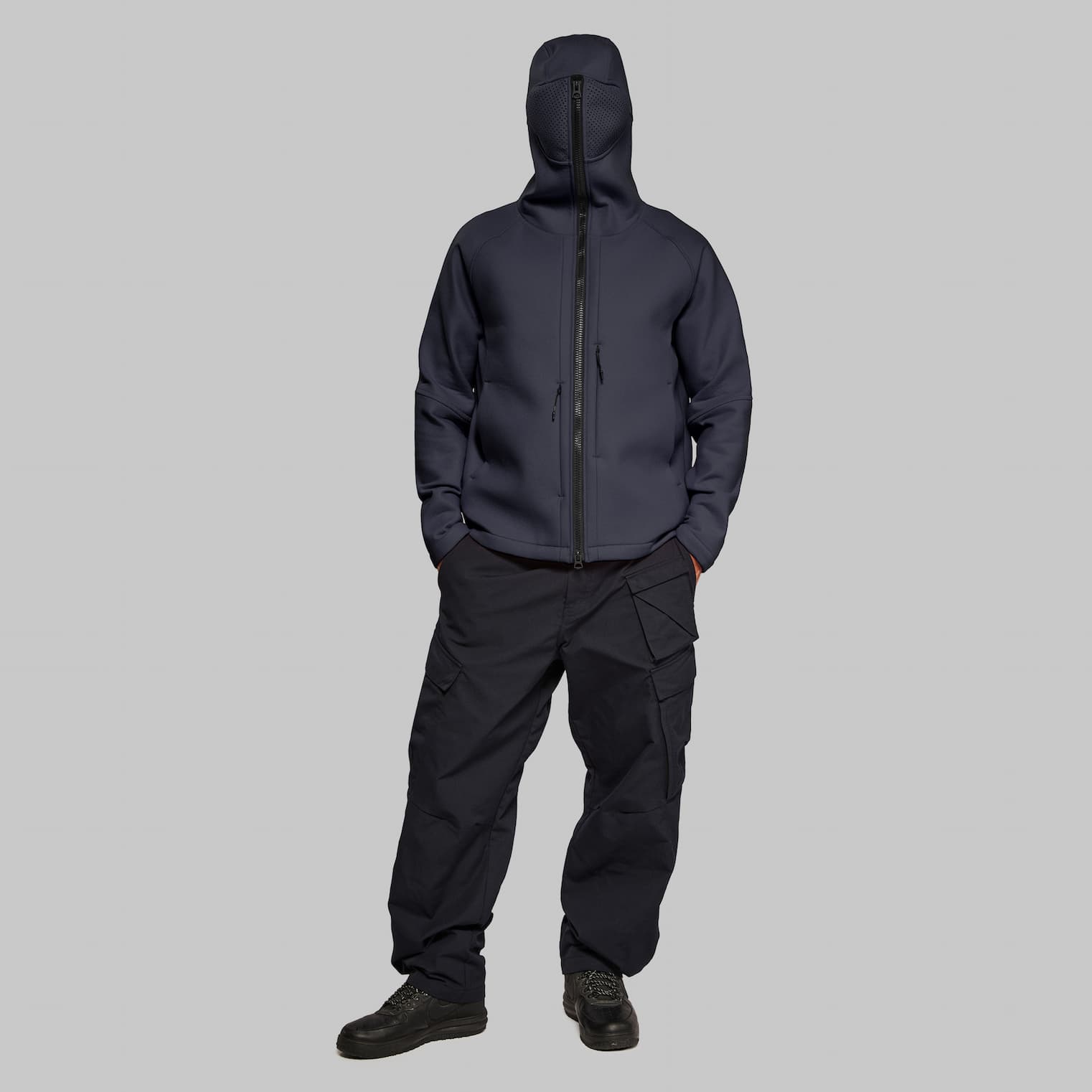
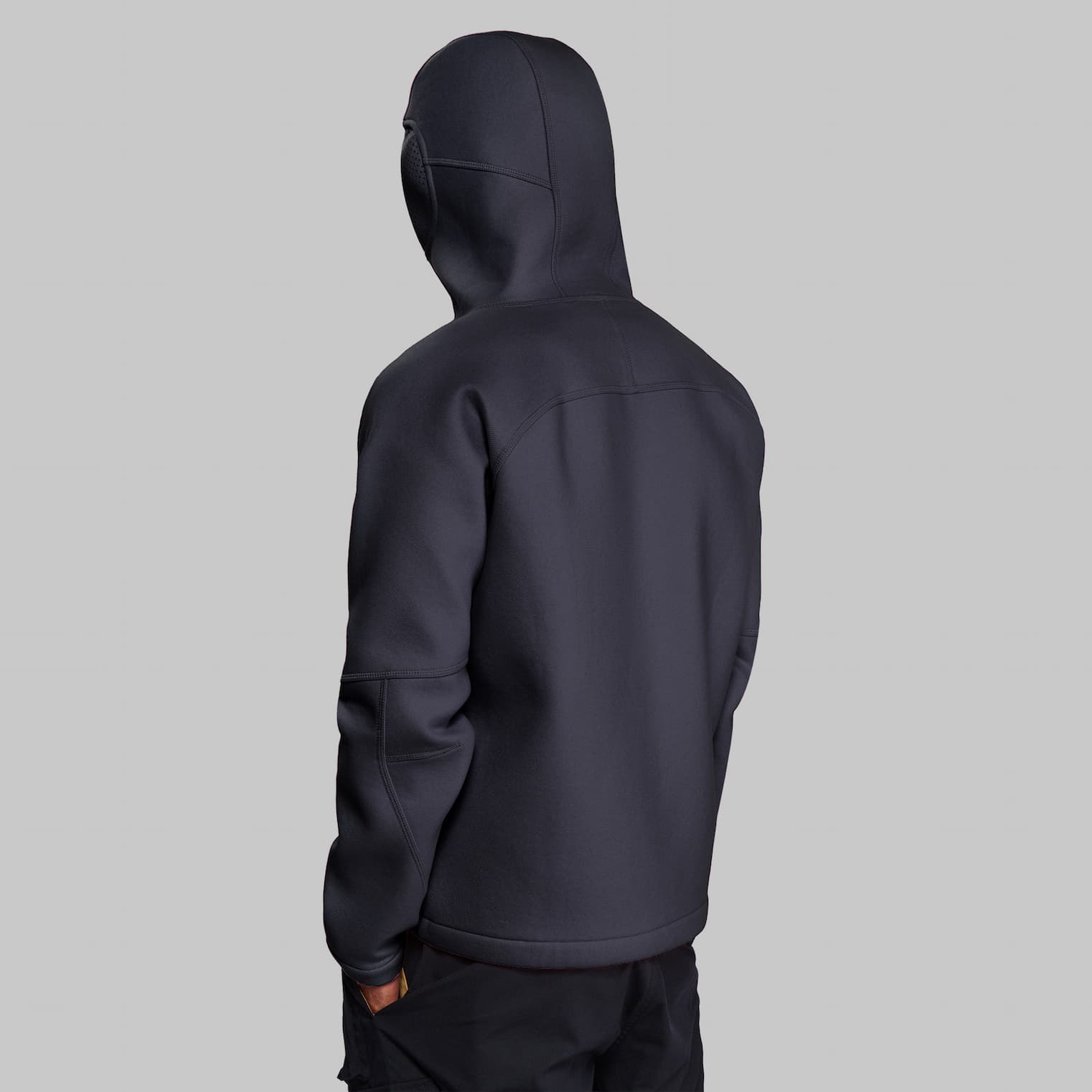
It can help you run faster, climb higher and survive colder conditions. But can it help you do less? In 2015 we launched a hoodie that zipped over your face. It came in a dusty bubblegum pink developed by a scientist to calm violent prisoners. The Relaxation Hoodie was our attempt to create a womb-like, wearable isolation tank, clothing that could slow you to a complete stop. Or as Wired magazine put it at the time, to “induce calming oblivion”. Just over a decade on, with more and more science insisting on the need for meditative time-outs, we’ve rebuilt it in a better material and a more engineered design.
The problem is switching it off.
We launched Vollebak with the Relaxation Hoodie, a wearable isolation tank designed to help you do absolutely nothing. Now it’s back in the colour of the great cosmic void and the dead of night. Downtime just got darker.
In the 1970s Harvard’s Herbert Benson identified the relaxation response – the body’s opposite setting, where heart rate falls, breathing slows and the repair work starts – and showed you can bring it on deliberately. Around the same time the scientist Alexander Schauss concluded that a specific bubblegum pink could slow the heart rate and reduce aggression.In 1979 a naval prison in Seattle painted a holding cell in it and reported no hostile behaviour. Named Baker-Miller Pink after the 2 officers responsible, it soon picked up a nickname we prefer – Drunk Tank Pink.
It’s the colour we launched the Relaxation Hoodie in. Neuro Navy comes from the other end of the spectrum.The pink was designed to act on you. Navy just gives you less to deal with. It sucks in light so there’s less contrast for the eye and brain to process. It’s the colour of night, shade and withdrawal. And nobody will wonder which cell you’ve just been released from when you’re wearing it on the train.
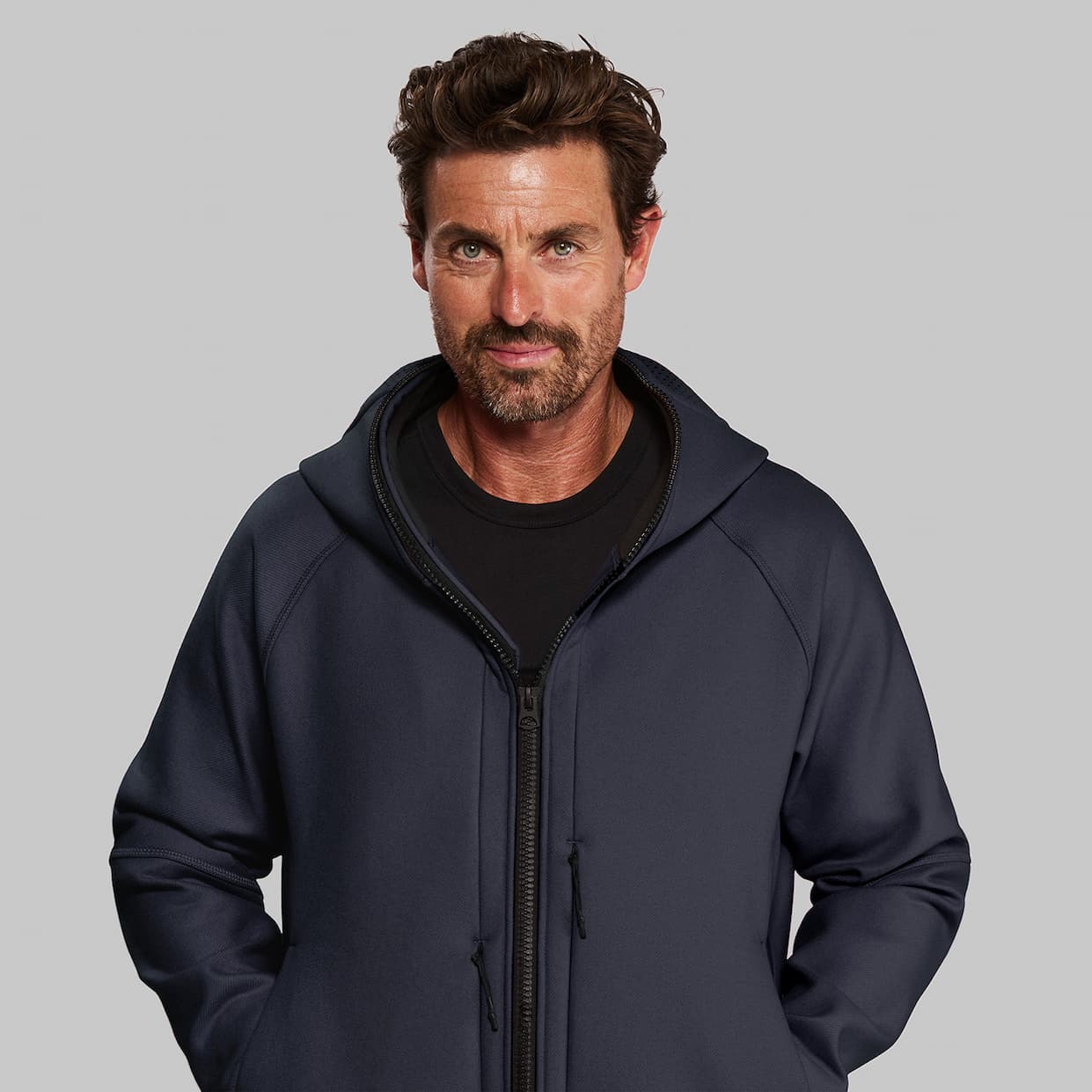
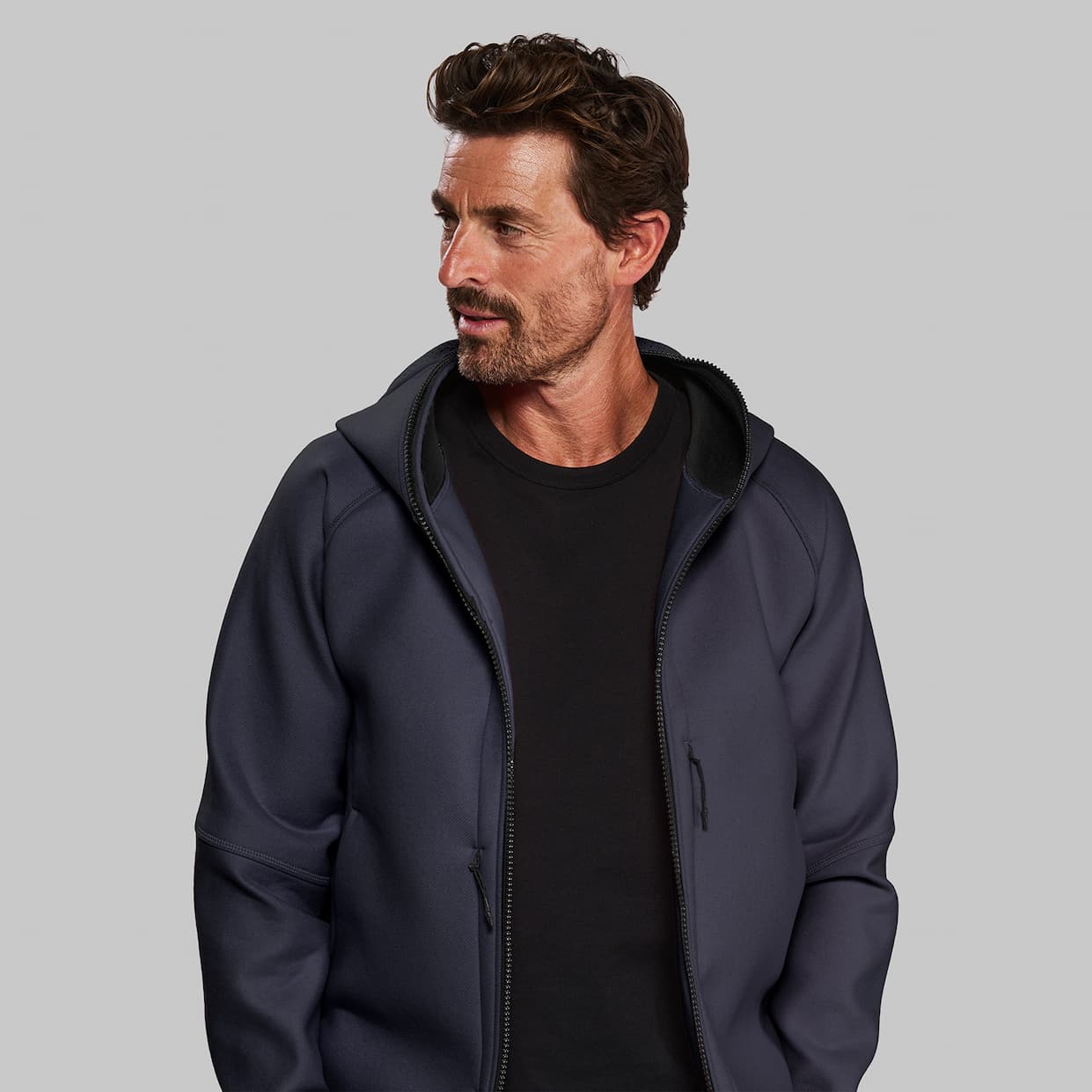
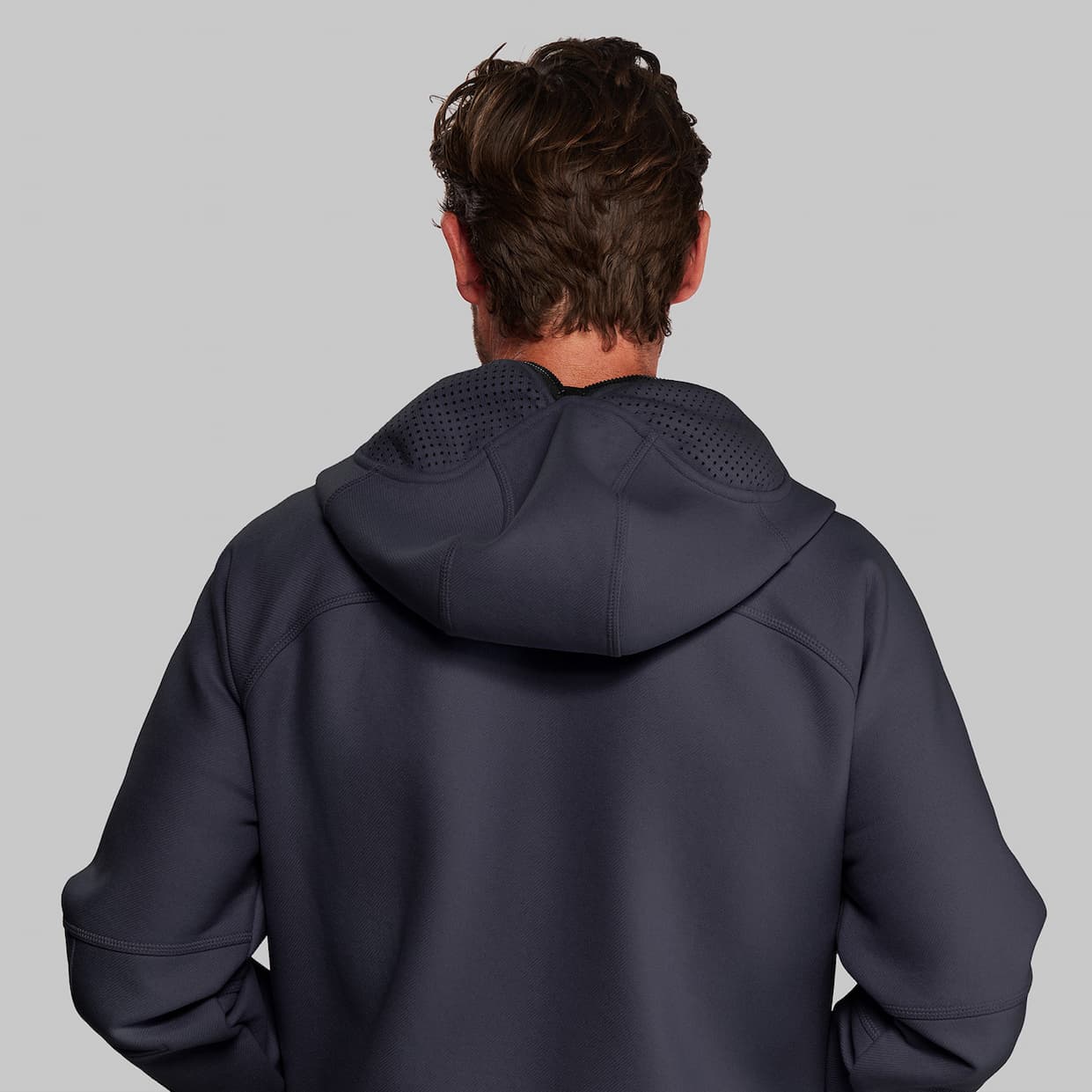
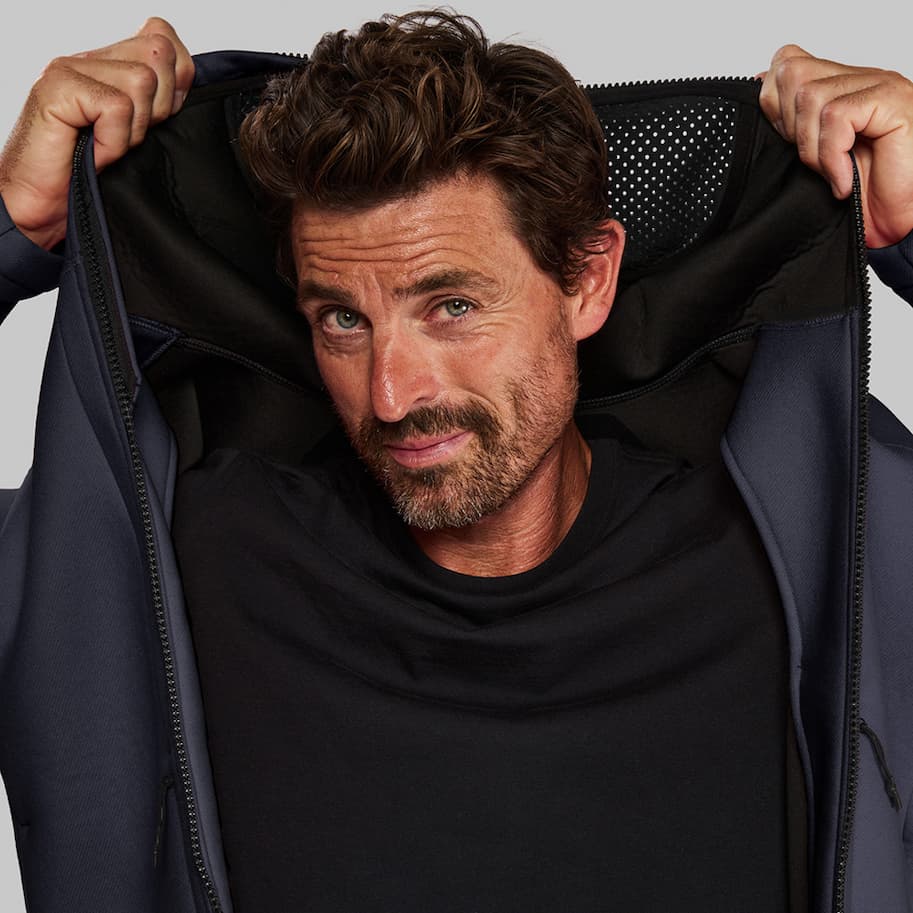
The soft shell is now a heavyweight bonded wool twill woven in Italy, dense on the outside and soft against your skin. The mesh visor of the original hoodie is now a laser-cut eye mask, so you can see out and nobody can see in. Asymmetric sling pockets hold your arms crossed over your stomach, and 2 side hand pockets are useful if you want to use it as a day-to-day hoodie. Raglan sleeves mean there’s no shoulder seam pressing into you when you lie down, every internal seam is coverstitched, bound or French-seamed, and grosgrain tape runs behind the 2-way zip so nothing hard touches your face.The Relaxation Hoodie now comes in Neuro Navy and the original Drunk Tank Pink, with a more generous fit than the original version.BUY THE RELAXATION HOODIE
-Laser-cut eye mask lets you see out but nobody see in -2 concealed sling pockets designed to hold your arms across your body in a comforting hug -Rebuilt in a super warm wool twill woven in Italy by Manteco
Our friends at thinktank C.D. Howe Institute have released a series of recommendations to boost Canada’s productivity.
October, 2026 – Canada needs coordinated reforms across multiple policy areas to address its longstanding productivity problem, according to the C.D. Howe Institute’s Productivity Blueprint, released today with recommendations for policymakers across different sectors and levels of government.
Canadians’ living standards have fallen behind those of other advanced economies.
From 2014 to 2024, real GDP per capita, a common measure of living standards, grew just 3.5 percent in Canada, the slowest among nine peer countries and far behind the United States, where it grew 20.2 percent.
Eight Key Policy Areas Needing Attention
Drawing on decades of non-partisan, peer-reviewed research, the Productivity Blueprint identifies eight policy areas that, together, can drive stronger investment, higher productivity, and better living standards for Canadians: tax reform and competitiveness; regulation; competition; human capital; innovation and commercialization; business growth; trade, transportation and supply chains; and fiscal policy and government productivity.
The Blueprint offers specific recommendations in each area.
On tax policy, for example, the Blueprint proposes cutting personal income tax brackets from five to three, replacing most credits and deductions with a $10,000 allowance, and lowering the general corporate tax rate to 10 percent. Past Institute work suggests these changes would unlock $140 billion in new business investment and add 2.5 percent to GDP.
But tax reform alone won’t close the gap. Weak competition in key sectors, low business spending on research and development, skilled newcomers working below their qualifications, and strained public budgets also hold productivity back.
Governments must address all eight policy areas together to make meaningful progress.
“The federal government has made some positive moves to address productivity growth, like the proposed Productivity Mega Deduction, the Major Projects Office, and Bill C-39. But there’s no quick fix for productivity,” says C.D. Howe Institute President and CEO Jeremy Kronick. “Real progress will take reform across many areas of policy at once, and the Blueprint provides a ready-made set of recommendations to achieve that goal.”
The Number One Priority
“If Canadians want stronger wages and living standards over the long term, raising productivity needs to be Canada’s number one priority,” says Kronick.
Your company’s marketing reports may say everything is working, but your revenue may tell a very different story. As businesses pour more money into SEO, paid media, social, PR, technology and AI, marketing and growth strategist Deborah Dodson warns that overlapping vendors, questionable ROI and feel-good metrics can allow underperforming investments to quietly drain substantial budgets. The article below identifies seven common marketing money traps and how businesses can separate activity from actual results to determine what’s truly generating customers and revenue.
The Marketing Accountability Gap Widens with More Spending Producing Less Clarity
Businesses have never had more ways to spend a marketing dollar, or more data supposedly proving those dollars are working. SEO agencies report rankings. Digital firms report clicks and conversions. Social teams measure engagement.
PR tracks visibility. Paid media produces attribution dashboards. Now companies are adding another layer as they race to optimize for AI-powered discovery.
Yet beneath all those metrics sits a surprisingly basic question: Which investments are actually generating qualified opportunities, customers and revenue? For many businesses, the answer is far less clear than the dashboards suggest.
Marketing and business growth strategist Deborah Dodson, founder and managing director of Strategic Alliance Marketing Group, sees a widening disconnect between marketing activity and business performance. With more than 20 years of experience spanning marketing, business development and growth strategy, Dodson works with organizations to scrutinize vendor performance, challenge recommendations and determine whether individual investments actually function as part of a coherent growth strategy.
“We’ve created an environment where nearly every marketing channel can produce numbers showing that it is working,” Dodson says. “The harder question is whether those numbers demonstrate that the business itself is benefiting.”
When Everything Is Working, What Is Actually Working?
The problem often develops gradually. A company hires an SEO agency. Later it adds paid advertising. Someone else takes over social media. PR operates independently. A new website launches. The company pays for directories, sponsorships, memberships and marketing technology. Eventually, what began as individual solutions becomes a sprawling marketing ecosystem in which multiple vendors have different objectives, reporting systems and definitions of success.
Dodson describes this as a kind of marketing stack creep. Businesses accumulate agencies, platforms, subscriptions and campaigns until it becomes difficult to see where responsibilities overlap, where money is being duplicated and whether all those activities still serve the company’s objectives.
“One agency reports that rankings are improving. Another points to clicks. Social media shows engagement. PR demonstrates visibility,” Dodson says. “Those can all be legitimate measures, but if nobody is looking across the entire operation and connecting those activities to business outcomes, you can end up with a lot of apparent success without knowing what is actually producing growth.”
That distinction is becoming increasingly important because activity is relatively easy to measure. Business impact is not. A campaign can increase traffic without improving the quality of prospects. Search rankings can rise without materially affecting revenue. Content production can increase without generating meaningful engagement. Multiple vendors can potentially claim influence over the same conversion. An impressive dashboard, in other words, does not necessarily mean an impressive return.
AI Is Making Attribution Even Messier
Artificial intelligence is adding urgency to the issue because it is changing where and how customers discover businesses. The customer journey was already fragmented. Now a prospect might encounter a company through Google, an AI-generated answer, LinkedIn, a map listing, online reviews, an industry directory, media coverage or another third-party source before ever visiting the company’s website.
According to Dodson, that does not mean traditional SEO is dead. It means businesses need a broader understanding of visibility. “SEO still matters, but discovery is no longer confined to a conventional search-results page,” she says. “Businesses need to think about the authority and credibility they are establishing across their entire digital footprint. The question isn’t simply, ‘Where do we rank?’ It’s increasingly, ‘Where are we being found, what does a prospective customer find when they encounter us, and does that visibility ultimately contribute to the business?'”
That encompasses websites and search performance, but also reviews, credible backlinks, media mentions, social presence, business profiles, directories and other signals that help establish authority across the web.
AI therefore presents businesses with a potential trap. In the rush to embrace the newest form of optimization, companies can simply add another vendor, platform or tactic to an already fragmented marketing operation.
Dodson believes the more useful question is not merely how much to spend on AI search optimization. It is whether the entire marketing budget needs to be reconsidered for an era in which discovery happens across so many different environments.
Seven Marketing Mistakes That Can Quietly Drain the Budget
According to Dodson, seven recurring mistakes deserve particular scrutiny because they can allow marketing spending to grow without a corresponding increase in meaningful business results.
1. Treating marketing as a collection of unrelated projects. Companies approve websites, advertising campaigns, SEO programs, social media initiatives and PR efforts independently, without a unified strategy connecting each investment to specific business objectives.
2. Paying multiple vendors for overlapping services. Agencies and consultants may duplicate work, pursue conflicting strategies or operate without understanding what other marketing partners are doing.
3. Mistaking activity for results. Rankings, impressions, clicks, followers and content volume can look impressive in a report while saying relatively little about qualified leads, sales opportunities or revenue.
4. Following an outdated SEO playbook. Search fundamentals remain important, but customers increasingly discover and evaluate businesses through AI search, maps, reviews, social platforms and third-party sources. Search strategy needs to reflect that broader reality.
5. Ignoring the broader digital footprint. A polished website cannot fully compensate for inconsistent business information, weak reviews, limited executive visibility or outdated profiles elsewhere online.
6. Buying visibility without questioning its value. Awards, directories, sponsorships, memberships and other paid opportunities can strengthen credibility when they reach the right audience. Others can become recurring expenses that survive year after year without anyone asking what they actually contribute.
7. Allowing vendors to grade their own work. When the company selling a marketing service also determines which metrics constitute success, Dodson cautions that an underperforming program can continue much longer than it otherwise might.
That final point exposes a larger accountability issue. “There is nothing inherently wrong with a vendor reporting its own performance. They should,” Dodson says. “But businesses also need an objective way to determine whether the metrics being reported are the metrics that matter to them. The measurement should follow the business objective, not the other way around.”
What If Every Marketing Expense Had to Earn Its Place Again?
One way to expose weak spots is to borrow a concept from zero-based budgeting and apply it to marketing. Instead of beginning with last year’s agencies, platforms, subscriptions, sponsorships and campaigns and deciding what to add, Dodson suggests periodically examining recurring expenditures as though they had to be approved again today.
Would the company still hire this vendor? Would it still purchase that directory listing? Does that platform serve a distinct purpose? Are two agencies performing overlapping functions? Is the organization measuring a channel because the metric matters, or simply because the platform makes it easy to report?
The exercise is not necessarily about cutting the marketing budget. “Sometimes the right answer is to spend less, but sometimes it is to spend more,” Dodson says. “And sometimes you don’t need to change the total budget at all. You need to move the money from something that isn’t contributing enough to something that has greater potential.”
That distinction is important. Dodson’s argument is not that SEO, advertising, PR, social media, directories or emerging AI strategies are inherently poor investments. Rather, marketing channels should not become permanent budget line items simply because they have always been there or because each can produce a favorable-looking performance report.
From More Marketing to Better Marketing
For marketers and business owners, the proliferation of channels creates an understandable temptation to be everywhere. Every new platform can look like an opportunity, and every emerging technology can create anxiety about being left behind.
But adding more activity to an already fragmented system can compound the very problem businesses are trying to solve. Dodson’s approach is to return to a simpler discipline: What is the business trying to accomplish? Who is it trying to reach? What role is each marketing investment supposed to play? How does it interact with everything else? And what evidence would demonstrate that it is succeeding?
Her underlying premise is that marketing does not necessarily need to do more. It needs to become more intentional, integrated and accountable. The goal is not a cleaner dashboard or another impressive metric. It is to make sure that the growing machinery surrounding modern marketing remains connected to the reason businesses invest in it in the first place: to produce meaningful business growth.
As marketing becomes more sophisticated, accountability has to become more sophisticated with it. The businesses that navigate this next era most effectively may not be those that adopt every new platform, metric or AI capability first, but those disciplined enough to continually question what each investment is accomplishing and whether it still deserves a place in the strategy. In a marketplace overflowing with ways to spend, knowing what not to fund may become just as valuable as knowing where to invest next.
As Major League Baseball wins new fans at home and from Asia to Latin America, replicas of player jerseys, caps and warm-up jackets are being worn by trendsetters worldwide.
U.S. baseball fans have long sought out merchandise that advertises their favorite players and teams. Increasingly, baseball-themed apparel is purchased worldwide, according to the data aggregator Statista, based in Germany. The sporty look of a baseball jersey is now popular on the streets of London and Tokyo and even on Milan’s fashion runways.
Demand stems partly from the growth in international fans — Japanese baseball enthusiasts, for instance, take great pride in the Los Angeles Dodgers’ Shohei Ohtani and the San Diego Padres’ Yu Darvish. But demand is also driven by fashion-conscious youth, who might know little about the game but like the look.
A feeling of connection
Hall of Famer Ken Griffey Jr. says baseball apparel forges a connection among players and fans. He says that, during his own 22-season career (with the Seattle Mariners, the Cincinnati Reds and the Chicago White Sox), he always appreciated spotting fans wearing his jersey.
“When you see your jersey outside of your home ballpark, on the road, it’s special,” Griffey says. “You want to do something special because of those people … who support, not only you, but the organization and the city.”
The former outfielder, who ranks seventh all-time on Major League Baseball’s home-run list, influenced today’s “baseball style” by popularizing the cap worn backward. Griffey’s is not a passing interest. Though retired from the league, he partners with Baseballism and Nike to help design baseball-themed clothing and shoes.
Baseball’s influence on fashion
Baseball historian Todd Radom, author of Winning Ugly:A Visual History of the Most Bizarre Baseball Uniforms Ever Worn, notes that what the players wear on the field has shifted over the decades, moving from conservative to brighter, bolder uniforms in the 1970s, and back to classic color schemes in the 1980s.
(State Dept.)
Creative Collaborations Introduce Alternate Styles And Colors
While uniforms today are largely designed with red, blue or black lettering set against a white or gray background, the league sells merchandise in a range of popular colors. It also engages in creative collaborations with casual clothing lines like Mitchell & Ness and Goat USA and high-fashion brands like Italy’s Gucci and Moschino, and U.S.-based Ralph Lauren.
Baseball-themed runway collections combine luxury materials (leather, cashmere or silk) and expressive overlays (crystals or floral and cartoon-character appliqués).
Moschino, for example, routinely blends oversized baseball jersey dresses with cartoon figures. And sportswear lines integrate stylized ballpark logos, team mascots and Looney Tunes, Sesame Street or Scooby-Doo characters.
Baseball’s comfortable jerseys and brimmed caps easily “adapt to whatever purpose you lTolike,” playing sports or looking stylish, says Erin Corrales-Diaz, a curator at the Toledo Museum of Art and author of The Iconic Jersey: Baseball x Fashion.
Historic Jerseys Are Being Reproduced
The Philadelphia-based Mitchell & Ness Nostalgia Company reproduces historic jerseys for customers who want to recapture their childhood sports memories, says Lynn Bloom, a company director. Superstars’ jerseys are always popular, she says, and Griffey’s consistently ranks among the company’s top-10 sellers.
He’s thrilled. “I always like seeing my stuff out there,” he says. And when fans wear a player’s jersey, “you know they feel that they’re a part of the team.”
More than 500 leaders and experts, including 15 ministers and nearly 150 CEOs and chairs, will gather in Dubai from 13 to 15 October for the inaugural Annual Meeting of Global Future Leaders.
The meeting will connect today’s decision-makers with the next generation of leaders to develop forward-looking responses to shared challenges and strengthen resilience in a volatile world.
New research will be published during the meeting on youth, leadership, innovation-driven solutions to sustainability challenges and data-centre infrastructure.
Follow the Annual Meeting of Global Future Leaders 2026 here and on social media using #AMGFL26.
Dubai, United Arab Emirates, October 2026 – The World Economic Forum, in collaboration with the Government of the United Arab Emirates, will convene the inaugural Annual Meeting of Global Future Leaders in Dubai from 13 to 15 October 2026. Opportunity-driven and future-oriented, the meeting will provide a platform for emerging and established leaders to create new opportunities for all and build resilience amid uncertainty.
More than 500 next-generation leaders and experts, including 15 ministers and nearly 150 CEOs and chairs, will engage in intergenerational dialogue on pressing global challenges and the partnerships needed to address them. Participants will include members and alumni of the Forum’s Young Global Leaders community, alongside select Global Shapers and Social Innovators, as well as leaders from government, business, academia, science, technology and civil society.
Reflecting both the persistent concerns highlighted in the WEF’s Youth Pulse 2026 and the striking optimism young people have expressed in Youth Pulse findings over the past decade, meeting participants will examine how AI and other frontier technologies are reshaping jobs and opportunities. Discussions will also consider economic uncertainty, geopolitical change and climate challenges and explore practical responses in a shifting global and regional landscape.
“The decisions we make today will shape the world the next generation inherits. Emerging leaders should have a voice in those decisions, not just live with their consequences,” said Alois Zwinggi, President and CEO, World Economic Forum and Principal Chairman of the Annual Meeting of Global Future Leaders. “This inaugural meeting will bring different generations and perspectives together to look beyond immediate challenges and work together on practical ideas for the decades ahead.”
“This meeting reflects the strong partnership between the UAE Government and the WEF, and a shared commitment to advancing international cooperation and constructive global dialogue. At a time of rapid technological, economic, and geopolitical transformation, preparing future leaders is more important than ever,” said HE Mohammad Al Gergawi, Minister of Cabinet Affairs of the United Arab Emirates and Principal Chairman of the Annual Meeting of Global Future Leaders. “By bringing together emerging voices from around the world, we aim to equip them with the insights and tools needed to turn challenges into opportunities for innovation, growth, and sustainable development.”
The event will be co-chaired by Milojko Spajić, Prime Minister of Montenegro; Ohood Bint Khalfan Al Roumi, Minister of State for Government Development and the Future of the United Arab Emirates; Fadel Adib, Professor and Entrepreneur, Massachusetts Institute of Technology; Khalfan Belhoul, Chief Executive Officer, Dubai Future Foundation; and Mirjam Staub Bisang, Chair, BlackRock Switzerland.
The programme will be organized around six strategic themes designed to advance dialogue and joint action across generations. Topics will include geopolitical uncertainty, technological disruption, economic resilience and prosperity, leadership, science and innovation, and climate and nature. Sessions such as Trust Test for Agentic AI, Working the Line: Humans and Machines, Trade in a Changing World and Economics after Certainty will examine issues likely to define the coming decade. Select sessions will be livestreamed here.
The meeting will also launch Future20, bringing together 20 next-generation leaders working across growth, innovation and resilience to create opportunities for current and future generations. New research will include a Leadership Commitment Framework, Middle East and North Africa-focused analysis of AI applications for sustainable development and data-centre infrastructure optimization. Insights from the meeting will inform the Forum’s ongoing work, including the Strategic Intelligence gathering in Geneva and the Annual Meeting 2027 in Davos-Klosters.
About the Annual Meeting of Global Future Leaders 2026 To strengthen intergenerational dialogue and practical collaboration on issues shaping the future, the World Economic Forum will bring together more than 500 leaders and experts in Dubai, United Arab Emirates, on 13–15 October 2026 for the inaugural Annual Meeting of Global Future Leaders.
Today 10 October, Vilnius’ leading contemporary MO Museum has opened How to Feel Real. Art, Technology and Us, exploring how technology is changing the way we experience reality. This opening also features an unusual guest: Poland’s viral humanoid robot influencer Edward Warchocki.
● Humanoid robot Edward will move through the museum and interact with visitors, respond to artworks, and take part in the opening program.
● The showcase is not a traveling exhibition, but developed through an intensive co-creative process in collaboration with Germany’s ZKM | Center for Art and Media Karlsruhe, one of Europe’s leading institutions for media art.
● It brings together more than 40 artists, from media art pioneers to contemporary artists working with AI, algorithms, and immersive technologies.
● Among them are Nam June Paik with his famous Internet Dream, Christa Sommerer, Laurent Mignonneau, and Anna Ridler.
Humanoid Influencer Edward Warchocki Is Heading to New Vilnius Exhibition, Asking What Does it Mean to Feel Real
October 2026 – Vilnius, Lithuania. Housed in a contemporary building designed by world-renowned architect Daniel Libeskind, MO Museum has become a leading force in the country’s modern cultural scene.
The new exhibition features landmark works from ZKM’s collection, which has a long-standing focus on Eastern Europe, and marks yet another collaboration with the MO Museum. How to Feel Real explores questions that are becoming increasingly urgent in a world shaped by technology: how do we feel real, and what does it mean to be alive?
One of its first visitors to see the artwork at MO Museum will be a humanoid robot from Poland.
Edward Warchocki, Poland’s first viral humanoid robot influencer, will join the MO Museum exhibition opening.
Built on a Unitree G1 humanoid platform and developed by Warsaw-based MERA Robotics, Warchocki has been given his own public persona, voice, and social media presence. In 2026, he moved from being a robotics project to an internet personality. Edward became a viral sensation after footage of him chasing wild boars through the streets of Warsaw spread online. He has since appeared in Poland’s Parliament, met senior politicians, and become a familiar figure on Polish television.
“Quite a few of the works in How to Feel Real explore artificial intelligence, automation, and the ways machines are increasingly taking on roles we once considered distinctly human. Bringing Edward into the museum is a playful extension of this idea, as his deliberately human-like and slightly absurd persona makes the questions raised by the exhibition tangible – inviting us to wonder why we are so eager to find the human in a machine,” said Milda Ivanauskienė, Director of MO Museum.
During the event, Edward will move through different spaces of the museum, interact with visitors, comment on artworks, and take part in the opening program in Lithuanian, English, and Polish languages.
“People keep asking me if I’m real, so when I heard about an exhibition asking what ‘real’ actually means, I thought: finally, someone is asking the right question. I’m coming to the beautiful Vilnius to see what the artists have to say – and, of course, to check whether they think I’m real,” said Edward Warchocki.
The exhibition moves beyond the familiar divide between techno-optimism and techno-pessimism. Alongside critical works about technology and power, visitors will encounter playful experiments, immersive environments and new aesthetic forms.
Organised around some of today’s most pressing themes – connection, automation, intelligence, body, and agency – the exhibition brings together works created predominantly from the 1990s to the present day. Together, they trace a conversation between artists’ early encounters with computers and the internet and contemporary responses to AI, and the growing digital mediation of everyday life.
“Our aim was to explore the latest technologies – including AI, quantum computing, robotics, and biotechnology – through the artists’ works. Art goes beyond the technology itself; it’s about broader questions regarding how we interact with technology and, thus, with the world,” said Philipp Ziegler, Head of Curatorial Department, ZKM | Center for Art and Media Karlsruhe.
More than 40 of the exhibition’s artists explore the shifting boundary between humans and technology. A definite highlight is the work Internet Dream from 1994 by media-art pioneer Nam June Paik. This massive media installation with 54 old CRT-monitors offers a glimpse into the era of the emerging global connectivity via the internet.
Another participant is the UK’s digital art studio Universal Everything, whose Infinity creates an endless stream of digital figures. Generated in real time by an algorithm, each figure combines different colours, textures, and body shapes, so no two are quite the same. The work has appeared in Germany’s ZKM, Italy’s Museo Nazionale della Scienza e della Tecnologia Leonardo da Vinci, and 180 Studios in London.
Christa Sommerer and Laurent Mignonneau are pioneers of interactive art, and their A-Volve is one of the works that established their international reputation. Visitors create virtual organisms through their own movements, then watch them interact, reproduce, and compete within a simulated ecosystem. The work won the Golden Nica for Interactive Art at Ars Electronica in 1994.
Anna Ridler from the UK similarly explores how machines learn from human-made material. In The Shell Record, she trained a generative AI system on images of shells she collected along the River Thames, turning the collection into moving-image works. The project connects the human act of collecting with the history of shells as stores of value and one of the earliest forms of currency.
How to Feel Real. Art, Technology and Us runs at MO Museum from 10 October 2026 to 29 August 2027.
There are great ruins all across the world. In many cases, they are places where history seems to have exhausted itself: remnants of distant cultures that have long passed beyond living memory.
But the Acropolis is different.
For thousands of years, the civilization that built what stands behind me has captivated the imagination of the Western world. Generations of our statesmen, artists, and philosophers have looked to it – they’ve looked to it with wonder and they’ve looked to it with awe.
Now time has a tendency to dull the senses: great victories and catastrophic defeats, they seem to shrink to becoming like a footnote in a textbook, another fact for our schoolchildren to memorize and forget. But the Greeks of antiquity, they seem to have an almost mystical hold on our memory. They call us back to them, again and again.
480 years before Christ, the armies of Xerxes arrived in this city and they put its sanctuaries to the torch. Most Athenians had by then evacuated by ship to a nearby island. But there was a handful of them that refused to leave their home. So instead, they barricaded themselves in the rocky fortress of the Acropolis to fight an extraordinary last stand, heaving massive stones down the cliffs onto the Persian invaders and holding the greatest empire of the age at bay for days. They were eventually overwhelmed. The Persians plundered the temples, burned the shrines, and razed the Acropolis to the ground but when the Athenians returned, they gathered the broken remains of the old Acropolis and buried them in the hill where it had stood. And decades later, under Pericles, they raised the Parthenon.
For 25 centuries since, the Parthenon has stood. Empires have risen and fallen beneath its shadow. And the progeny of the men who built it – the sons of Athens and Rome – have carried their civilization with them to the ends of the Earth.
Two and a half centuries after the founding of the American republic halfway across the world from where I stand now – I stand here today as the Secretary of State of that republic, and a great-grandson of settlers who arrived in the new world from Spain – I stand here to testify to a debt that no lapse of time, no distance of space can ever extinguish.
The history of America, the history of my country, is covered with the fingerprints of antiquity. Greece is literally carved into the architecture of our government: in the towering columns, in the domes and the monuments across our capital city. The city where our Constitution was born – Philadelphia – is itself a Greek name.
The men who founded my country were fascinated by the heritage we inherited from yours. They were exceptionally well-read in history – they were vividly aware of their unique place in it – but no other age of the past held their attention or their imagination quite like that of antiquity. Many, many people are surprised to learn that the most commonly cited author in the Federalist Papers was not an Enlightenment philosopher or political theorist. No, the most commonly cited author in the Federalist Papers was Plutarch, the Greek biographer of Greece and Rome’s great men.
Now, much has been written and said about the influence of ancient Greece on the ideas of the American Founders – and, for that matter, on all of the Western philosophers and statesmen that preceded them. Most of us are familiar with the basic history. Athens gave us democracy. Plato and Aristotle gave us Western philosophy. Our ideas of law, of virtue, of citizenship, and republican government were shaped in the Greek city-states. Even much of our political vocabulary – words like democracy, tyranny, the word “politics” itself – found its origins here.
Now, all of that is true. But the things we owe to this place – as Americans, and as Westerners – are actually far far deeper. These institutions and ideas – these institutions and ideas were the outward expression of more fundamental qualities we see in the ancient Greeks – qualities that can’t be reduced to any particular political system or theory.
Here, in Athens, we found the first full realization of all the essential traits that would come to define the West: fierce individuality and relentless ambition; daring exploration and invention; a yearning for discovery, for adventure, risk and glory. An insatiable curiosity about the world and the principles by which it operates, a hunger to know the mysteries of nature and grasp the secrets of the cosmos. An impatience with the notion of impossibility, chafing at all boundaries and limits, straining to peer into the depths of the unknown.
These were not just the formulas or precepts of a particular school of philosophy. They were the characteristic of a people – expressed in their traditions, their stories, their imagination; in the qualities they demanded of their citizens; in the things they lived and fought and died for.
To know them is to know ourselves.
What blossomed here in this place was the Western desire to uncover all that ignorance, darkness, and distance had kept hidden from the mind of man. The Greeks did not just shape history; the Greeks gave us history itself. Much about – much of what we know about many ancient civilizations comes almost entirely from the records of Greek explorers and historians, explorers and historians who didn’t just chronicle the histories of their own people, but ventured outwards to observe and record the sagas of foreign peoples and cultures all across the world.
Where others looked inward, the Greeks were the first to direct their focus outward, to chase the thrill and glory of seeing all that was strange and new. It was this trait – it was this trait that would push the West to create and build things that others could not, marking us out from so many other cultures and civilizations where stability and subsistence were the highest ends of life.
But it is not just the ambition to explore the unknown that we inherit from the Greeks; it is the conviction that the unknown canbe known. The confidence that the world can be charted and measured and mapped and understood – and that there is a rational order to the cosmos, governed by certain fundamental laws, laws that men can observe and the mind can come to understand.
This was the foundation of the Western mind: our math, our science, our medicine. Our philosophy, ethics, and religion. It paved the way for the gospel of Jesus Christ to find fertile soil in Europe and flourish into the empire of Christendom. It was the foundation of the riches of Christian theology – of Augustine and Aquinas and the whole tradition of natural law.
It gave birth to a civilization marked not just by a common culture, it was marked by a common anthropology – a common view of man and his place in the universe. Its descendants would share not just the idea of a natural order, but a distinctive understanding of virtue; of destiny and fate; of truth, goodness, and beauty; of a code that dictates how men ought to live; of objective standards and ideals to strive towards.
For the Greeks of antiquity, the pursuit of excellence was the very principle of man’s existence. They organized all of civic life around contest, ambition, competition: in philosophy and poetry, in sculpture and drama, in athletics and art, in war and statecraft. The classical Greek city was an arena for great men to test and prove themselves, to hone their potential through perpetual struggle – to be the best, the strongest, the most beautiful, straining to inch ever closer to perfection.
Now I know that to modern ears, what I just described, this way of life, may sound odd; it may even sound cruel. The ideal of many ideologies in our time has, frankly, become a world of perfect safety, devoid of risk or failure, with neither the glory of victory nor the shame of defeat. Too often these days, we build downwards. We design our standards to ensure no one will lose; we preoccupy ourselves more with the comfort of the worst than the potential of the best. We hold the most exceptional things among us hostage to the average, the ordinary, the mediocre.
The men who made the Parthenon, they built upwards.They held that the highest and most noble aspiration in life was to surpass all others, to strive to be the best in all things. The ancient Greek city-states were filled. They were filled with intense passion and rivalry and faction and conflict. But from that constant struggle for distinction – from that came the great flowering of art and philosophy and political and intellectual energy that would transform a collective of Mediterranean cities into the birthplace of the greatest civilization in the world.
The thumos, as the ancient Greeks called it – the fire of passion, strength, courage, pride – is the heart of great civilization. And without it? Without it, nations lose their will to fight, the will to strive, the will to survive.
Marco Rubio was sworn in as the 72nd Secretary of State on January 21, 2025. The Secretary is creating a Department of State that puts America First.
Today, too much of the West has forgotten this quality. Over time, we in the West came to feel ashamed of the very things that made us exceptional. We felt embarrassed that our achievements set us apart from the rest of the world. Our prosperity somehow became a source of guilt. We no longer believed we deserved and had earned our greatness.
The word “nationalism” became a dirty word. And so we tore down our monuments; we condemned our own history. And in too many places, we taught our children to be ashamed of the countries they would inherit. In the process, we opened our borders and outsourced our industry, and allowed our militaries to wither and to decay.
And with every passing year, we seemed to outsource more of our sovereignty, transferring our decisions to global bureaucracies far beyond the reach of our control.
But others were all too happy to fill the vacuum that we left – the vacuum left behind by our weakness. And as the West’s confidence faltered, its adversaries and its rivals only grew more assertive, building up their own wealth and their own power in our stead.
And now, today, we find ourselves at a crossroads. Because the next decade and the decisions we make will write the story of the next century. The course we take will determine whether the West maintains its place at the head of the world or resigns itself to a future of atrophy and servitude and decline. We will either choose to act now or lose the choice to act at all.
Under President Trump, the United States has made its choice. We choose the unapologetic pursuit of national power: to take back control of our critical supply chains, to reindustrialize our economy, to rebuild our defense, to fight for dominance of the technologies and industries of the future.
We choose to reach for new frontiers: in advanced manufacturing and super intelligence; in drones, weapons, and warfare; in chips, minerals, cyber, and every other domain of human possibility. To unleash our energy, to rebuild our factories, to return our astronauts to the moon and launch a new age of exploration in space.
Now for all their lofty ideals, the ancient Greeks were not naive. They understood that nations have interests. They understood that statecraft requires prudence and diplomacy, but they also understood that it requires the ability to wield force when prudence and diplomacy fail. They understood that power requires not only having the means to defend yourself, it requires the credibility that you are willing to use it.
This is the classical understanding of politics and of statecraft that the Trump Administration hopes to reclaim – reclaim not just for our country, but for the whole of our civilization.
We believe that Europe can awaken from its long slumber and rekindle the fire that was lit here millennia ago.
There are already signs.
Across this continent, we are witnessing what we hope will be the beginnings of a generational shift: skyrocketing defense spending, a flurry of new partnerships and programs, expanded manufacturing and production, following on the historic defense commitments made last year in The Hague.
Greece has been at the center of this shift. The people of this nation have proved themselves once again to be an indispensable friend to Europe and to the United States alike, on everything from energy to migration to defense, where Greece has been a model ally.
And it’s our sincerest hope that all of Europe will follow your example.
Though passions may, at times, have strained the bonds of affection between the United States and Europe, it must not be allowed to break them. Together, we must strengthen an alliance capable of confronting threats of our age.
And we can. Because we do not believe the transatlantic friendship should be zero sum. Quite the opposite: our vision is of an alliance whose strength is greater than the sum of its parts. It is a vision we saw in action just last month, in an unprecedented new agreement between the United States, Denmark, and Greenland – an agreement that will reshape the Arctic and bolster the security of all of NATO. All three partners in that deal emerged victorious. All of Europe – and NATO and the United States emerged safer, stronger, and more secure because of it.
We want to win together. We must win together.
Now it’s has become fashionable today to believe that enlightened foreign policy means prioritizing the global community over one’s own people. And I think here, too, we have much to learn from the men of ancient Greece because they knew that there was nothing selfish or wrong about loyalty to your nation, nor anything selfish or wrong about fighting to defend its interests above all else.
They believed – fiercely – in the ideal of the great man: the exceptional individual who obtains immortality through his own deeds. But they believed that glory and fame, those things were won through striving, sacrificing and achieving greatly for something larger than yourself. The recurring hero of the ancient Greek world was the man who was willing to pay any cost for a cause worthy of his loyalty.
We see this in Socrates, who refused to abandon the inquiry into truth even at the cost of his own life. We see it in the legendary stand of 300 Spartans – surrounded and hopelessly outnumbered by the vast armies of Persia – who refused the chance to save themselves, choosing to fight to the last man rather than abandon their post or abandon their duty. And we see it in the epic myth of Achilles, who is offered the choice to return home and live a long and peaceful life – but chooses instead to remain at Troy and perish in pursuit of eternal glory.
These – these are the qualities that would shape the Western moral imagination. From the Christian martyr who refused to betray his faith to the patriot who gave his life for his country; from Saint Thomas More to the Battle of the Alamo, running through the immortal closing words of the Declaration of Independence of the United States which says, “We mutually pledge to each other our Lives, our Fortunes and our sacred Honor.”
It is from the Greeks that the West inherited its sense of duty – an unbreakable loyalty to one’s code, one’s cause, one’s country. Our heroes, the heroes of the West are those who choose to remain faithful to their duty precisely when it is most difficult and painful to do so: the man who is bound by his word, the soldier who will not abandon his post, the captain, the proverbial captain, who goes down with his ship.
This is wholly different from what we see, even now, for example from fanatics like the radical mullahs of Iran, whose cult of death hails child suicide bombers as national heroes, and portrays martyrdom as an end to itself.
Our heroes – our heroes may be willing to die for their cause; but our heroes do not worship death. It is precisely because we value life that we come to recognize the heroism in those who would sooner sacrifice it than to betray their principles. Now, we take the West’s conception of these things – heroism, honor, duty – we take these things for granted. We assume that these somehow are universal to all people in all times and in all places. They are not. They are the product of a distinct character, a distinct character which arose here and shaped the whole story of the civilization that came after it. A civilization that we must fight to defend today with the same passion as our forefathers did.
The men who built the Parthenon were succeeded by the architects of European Christendom, who raised the cathedrals of Milan, Cologne, and Florence. The quest to perfect the human form that moved the ancient Greek sculptors found a new expression in Michelangelo. The Greek philosophers’ search for the structure of the universe was inherited by Copernicus, and then Galileo, then Kepler, and in Newton.
The hunger for new knowledge, that’s what gave birth to Magellan’s first expedition around the world, to Columbus’ discovery of the Americas, and ultimately to Apollo 11’s journey to the moon. And the qualities that led Alexander to conquer the entire known world reappeared in Caesar, then Charlemagne, and Cortes.
And in America, that same tradition rediscovered itself anew. An open and wild land became the site of a great revival of Western imagination and ambition. The Greek aspiration for new horizons became the American frontier spirit. The civilization of Athens and Rome transformed an infant seaboard republic into a continental empire.
The greatest Americans of every generation have carried the unmistakable features of their forefathers – born in Athens, formed by Rome, baptized in Christendom, hardened in the furnace of medieval Europe, endowed with the English genius for liberty, and then carried across the Atlantic to be reborn on the shores of a new world.
Together, we must now rediscover that spirit. We are at an inflection point – an inflection point not only in the history of my nation, but an inflection point in the whole of our civilization.
The threats we face today are every bit as real as they were on the dramatic stage of antiquity.
National interests did not vanish in the face of international institutions. War did not disappear simply because we preferred peace. Other states continued to arm, to seek influence, to compete for territory, and technology, and resources, and markets, and energy, and power.
And now, there is war again. There is new competition between great powers again. There is vulnerability, aggression, terrorism, a whole universe of new threats and attacks again.
And so we must rebuild our institutions and our alliances to face these threats together – understanding that the purpose of these things is not to abolish the sovereignty of the nations that constitute them; it is to defend them. And that nations need not abandon their distinct identities in order to recognize their common interests.
We have built a model of that with our partners here in Greece. In our defense partnerships, in energy and technology, in our shared ambition to secure Europe’s borders from the threats of mass migration.
Our friendship dates back to the earliest years of my nation. When Greece rose in 1821 to recover its independence after centuries of Ottoman rule, Americans recognized something familiar in that struggle. Three years later, the great American statesman Daniel Webster, he delivered a famous address to Congress, helping bring the cause of the Greek Revolution before the representatives of the young American republic.
And he began by calling their attention to everything around them. This is what he said in his speech; he said: “This free form of government, this popular assembly… this practice of free debate, and public discussion, the contest of mind with mind… even the edifice in which we assemble, these proportioned columns, this ornamented architecture, all remind us that Greece has existed, and that we, like the rest of mankind, are greatly her debtors.”
Those words are as true today as they were when he said them. And all of us – not just Americans, but Europeans and our friends across the West – must relearn the lessons our forefathers took from this place and from its history.
The history of Greece – the history of Greece does not just offer us a glimpse – it does not offer a glimpse of our institutions in their earliest forms. The history of Greece shows us an image of ourselves.
It shows us that ours is the inheritance of great heroes, and that we should be proud – that we should be intensely proud – of where we come from. We should marvel at what our forefathers carved out of this countryside. The story of our civilization is the greatest story ever known to man. And it began here, with the first men and women of the West. From them – from them – we can rediscover the virtues, the courage, and the strength to confront the dangers that we face in our time.
With its marble columns and towering dome, the U.S. Capitol is one of Washington’s most beautiful structures and a striking example of how classical architecture has influenced America’s civic buildings.
President George Washington, who laid the Capitol’s cornerstone in 1793, and Secretary of State Thomas Jefferson saw the architecture of ancient Greece and Rome as emblematic of their new nation’s democratic ideals. To Jefferson, classical architecture’s large entrances and symmetrical layouts symbolized openness and equality, values embodied in the U.S. Constitution. Washington commissioned French architect Pierre L’Enfant to create a classical design for the nation’s capital city.
“They sought to use classical architecture to visually connect our contemporary Republic with the antecedents of democracy in classical antiquity,” President Trump says in an August 28, 2025, executive order on restoring classical designs to American architecture.
The National Civic Art Society, which promotes meaningful public design, finds that 72% of Americans prefer traditional designs derived from classical architecture over modernist styles for federal buildings.
To David Gobel, a professor of architectural history at the Savannah College of Art and Design, those results aren’t surprising. “Classical architecture is a universal language,” Gobel says. “People don’t have to know their Doric, Ionic and Corinthian orders [of Greek architecture] to recognize that this is familiar, that it is the architecture of the ages.”
Classical architecture’s influence extends across America, most notably in state capitol buildings from coast to coast. American architects introduced stylistic variations, creating civic buildings that reflect both American culture and its natural landscape.
The U.S. Capitol wasn’t the first civic building in the United States to evoke Greek and Roman antiquity. That distinction belongs to the Virginia Capitol building designed by Jefferson in 1785.
Jefferson’s design recalls the Maison Carrée, an ancient Roman temple in Nîmes, France. Both buildings have a triangular pediment atop a wide, columned entryway. Yet Jefferson took a more streamlined approach, choosing simple Ionic columns, rather than the elaborate Corinthian columns seen on the Roman temple in France.
The Vermont State House in Montpelier, constructed in 1859, departs from classicism’s traditional use of white marble in favor of local gray granite, bringing a more rugged look tailored to its setting in the Green Mountain range.
The main lobby highlights national and local leaders with statues of Abraham Lincoln, the 16th U.S. president, and Revolutionary War hero Ethan Allen, who was one of Vermont’s founders.
The Capitol building in Michigan, built between 1872 and 1878, combines classical design with American practicality. Artisans in the iron-producing state painted the interior using trompe-l’oeil techniques to trick the eye and make iron and pine wood materials resemble more expensive marble and walnut.
Constructed between 1912 and 1916, the Utah Capitol combines granite building material with classical styles, including Corinthian columns and a dome. The building’s interior murals depict the state’s history and geography, with images of Mormon pioneers and covered wagons, as well as Utah’s famed Great Salt Lake and red-rock canyons.
American architects continue to add new flourishes to classical designs, says Gobel, the architectural history professor. Recent examples include the Federal Building and Courthouse in Tuscaloosa, Alabama, and the Charleston Gaillard Center, a performing-arts venue in Charleston, South Carolina. The Gaillard Center, completed in 2015, features interior columns crowned with palmettos, a nod to South Carolina’s state tree. Completed in 2011, the Federal Building in Tuscaloosa has a metal roof, a feature commonly used in southern architecture for durability and heat resistance.
“It’s a tradition dating back thousands of years, and it’s never stopped,” Gobel says of classical architecture. “Its purpose is not to represent a particular age or place, but something higher and greater to which we can aspire.”
Increasing Pressure on Canadian Community Organizations as Good Food Goes to Waste
State of Food Charity in Canada survey, conducted by Ipsos for Second Harvest, finds growing demand for food support and mounting pressure on community organizations
TORONTO, ON – October, 2026 – More people across Canada are turning to community organizations for help putting food on the table, while the organizations supporting them are struggling to keep up.
Turning People In Need Away
New findings from The State of Food Charity in Canada survey show that 89% of organizations surveyed saw an increase in demand for food over the past year. One in three (33%) has a waitlist for support, while 35% have had to turn people away due to limited food or resources.
Among organizations with a waitlist, the average was 878 people waiting for support. Of those that had turned people away, 41% estimated they had turned away more than 50 people, with an average of 269 people turned away.
“Every week, organizations like ours are seeing more families reach out for food support, including working families who never imagined they would need help,” says Vivian N. Etuka, founder and executive director of Bethel Outreach Community Services. “When programs are full or there’s a waitlist, hunger doesn’t wait. It means parents going without so their children can eat, seniors struggling to stretch what little they have and families choosing between groceries and rent, utilities or other essential bills.”
Where Second Harvest Fits In
At the same time, the findings point to an opportunity to make better use of food that is already available. On average, 36% of the food available at responding organizations comes from Second Harvest. Among respondents, 91% said Second Harvest enables them to access more food, while 85% said it helps them save money.
“Canada has enough food to come out of this situation, but too much good food is still going to waste while organizations supporting people are struggling to keep up with demand,” says Lori Nikkel, CEO of Second Harvest. “Connecting surplus food with communities is one practical way we can help strengthen the organizations that are already doing this essential work.”
The findings come five years after Second Harvest’s “Canada’s Invisible Food Network” research highlighted the thousands of community organizations across the country that provide food and other support to people experiencing food insecurity.
The new survey also shows that this network extends well beyond traditional food bank systems. Nearly half (49%) of organizations surveyed said they do not access food or other supports through the federal, provincial or regional food bank networks. Respondents included food banks and pantries, shelters, community development organizations, faith-based organizations, public institutions, and food recovery and redistribution organizations, among others.
An App For Businesses With Surplus Food
Through the Second Harvest Food Rescue App, food businesses can post surplus food that is available for donation, while local non-profit organizations can claim the food and arrange a pickup. The app helps connect surplus food with organizations serving people in their communities.
Food businesses can join it and connect their surplus food with local non-profit organizations.
About the Survey
The State of Food Charity in Canada survey was conducted by Ipsos for Second Harvest from May 29 to July 13, 2026. Ipsos distributed the questionnaire to 2,468 organizations in Second Harvest’s partner network. A total of 1,610 organizations completed the survey, representing a 65% response rate. The findings reflect the organizations that responded to the survey.
About Second Harvest
Second Harvest is Canada’s largest food rescue organization and a global thought leader on food waste and perishable food redistribution. It rescues unsold surplus food from thousands of food businesses from across the supply chain to redistribute it to non-profits in every province and territory. This prevents harmful greenhouse gases from entering the atmosphere while improving access to nutrition for millions of Canadians experiencing food insecurity. Beyond food rescue and redistribution, Second Harvest is deeply involved in advocacy, research, training and education. Its groundbreaking reports, such as “The Avoidable Crisis of Food Waste,” provide critical data and insights to inform public policy and educate the public on sustainable food systems.
Second Harvest is committed to driving systemic change, helping to shape policies and practices that reduce food waste and address its role in climate change, while also supporting communities by providing them with the food they need.
Sports betting has become a digital market that runs beyond the odds displayed on your screen. In July 2026, US sportsbooks generated $1.27 billion in revenue from $11.60 billion in wagers, the American Gaming Association reported.
Those figures show the infrastructure required behind every bet. Mobile platforms, data feeds, payment systems, geolocation tools and security controls must work together so transactions can move from your screen into regulated wagering systems at scale.
If you follow a game from your phone, the experience can feel simple. That simplicity depends on layers of technology handling account access, market updates, location checks and records, so the visible sportsbook becomes one part of a much larger operation.
Mobile access becomes the front door
For many customers, betting begins with an account as the starting point. A Betway login gives an existing customer access to the operator’s platform, where sports markets and account functions can be reached from a connected device.
The mobile model reflects the US market. The American Gaming Association reported $16.89 billion USD in commercial sports betting revenue in 2025, with online wagering driving most industry revenue. Your phone has become an important gateway into regulated sports betting.
You can check a market, review your account or follow a live event without leaving the same interface. A Betway login illustrates that shift because account access connects you with digital markets across sports and competitions in real time.
Real-time data changes the pace
One major technological change is speed. Sportsbooks receive data about scores, game situations and other events through data feeds, so markets can be updated as a contest develops for customers.
If you use a Betway login during a live event, you can encounter in-play markets reacting to developments during the contest. Betway currently lists in-play options across football, basketball, tennis and baseball, showing how live data has become part of the experience.
That speed also creates technical complexity. A market can be suspended when an important event occurs, then reopened after information is processed. Your screen can receive a broadcast later than the data used to manage the market.
Geolocation makes digital betting local
A smartphone makes sports betting portable; US regulation makes physical location critical to the transaction. In New York, mobile wagers must be placed from within the state, so licensed systems must establish where wagering activity originates.
Geolocation technology can use signals from devices and networks to determine whether a customer is inside an authorized area. If you open a Betway login while traveling across state lines, your account can remain accessible even when wagering access depends on your location.
That distinction matters because if you are in the USA, sports betting is regulated at the state level. Your digital account does not create a nationwide right to wager, so location technology connects mobile access with boundaries established by individual jurisdictions.
Payments become part of the experience
The technology behind sports betting continues after you select a market. Payment systems connect deposits, withdrawals and account balances, so a transaction can involve several processing layers before money reaches its destination.
For someone using a Betway login, the account interface provides a route into that financial system. Behind it, operators must manage transaction records and security controls, with regulators requiring systems that identify unusual wagering activity.
New York’s 2024 mobile market shows the scale involved: customers placed more than 1.7 billion mobile sports wagering transactions during the year, with more than $22.5 billion wagered. At that volume, automated processing is essential across platforms.
Security moves deeper into the account
Digital betting also creates a substantial security challenge. Operators have to protect accounts from unauthorized access, monitor suspicious activity and manage attempts to bypass location controls, so authentication has become important to the customer journey.
When you enter a Betway login, you are accessing an account connected to financial information and wagering records. Account security can involve identity checks, device information and controls confirming that the correct person is using the service.
Regulators are also examining stronger forms of authentication. New York has considered technologies including biometric methods for account authentication and wager placement, showing how digital security is entering the wider regulatory discussion around mobile sports wagering.
The market becomes a technology business
The scale of modern wagering makes technology more than convenience. New York recorded 1.706 billion mobile sports wagering transactions in 2024, so the systems supporting those transactions have to process huge volumes with speed and reliability.
If you use a Betway login, you see the customer-facing layer of that system. Behind the interface sit sportsbook software, data providers, payment infrastructure, geolocation services, security controls and regulatory processes, with each component supporting the completed transaction.
The direction is clear. Sports betting is becoming increasingly dependent on interconnected digital systems, so the quality of your experience depends on what happens behind the screen. That can mean quicker information and smoother access, with technology working quietly during every match.
Protecting Older People in Conflict and Disaster Zones is A Humanitarian Priority
Growing older can bring challenges that become particularly difficult in communities affected by poverty, displacement, conflict, or natural disasters. Health problems such as impaired vision, hearing difficulties, mobility limitations, hypertension, diabetes, and heart disease may become harder to manage when medical services are disrupted or unavailable.
Yet the challenges faced by older people extend far beyond physical health. The loss of a spouse, separation from relatives, displacement, financial insecurity, and prolonged isolation can leave many elderly people without the social and emotional support they need. In humanitarian crises, these vulnerabilities can become even more pronounced, especially when older adults are simultaneously responsible for children or grandchildren.
As the world marks the International Day of Older Persons, attention is increasingly turning to the need for humanitarian responses that do not overlook the elderly.
For Life for Relief and Development supporting older people is incorporated into a broader humanitarian approach that includes emergency assistance, healthcare, shelter, food security, water and sanitation, education, and community support.
We spoke with Sharon Leonard, Executive Administrator at “LIFE”, about the organization’s approach to elderly care and the experiences of older people living through conflict, displacement, poverty, and natural disasters. Against this backdrop, we spoke with her to discuss these issues.
Q: Why is support for older people an important part of humanitarian work, even during major emergencies?
Older people can sometimes become invisible during humanitarian emergencies because immediate attention naturally focuses on urgent injuries, displaced families, children, and other visible needs. But older adults are also directly affected by crises, and many have specific medical, financial, and social needs that cannot simply be postponed.
The demographic picture itself demonstrates why this issue deserves greater attention. UNFPA data indicate that people aged 60 and above already account for approximately 8% of the world’s population. The increase is particularly significant across Arab countries, where the elderly population is expected to grow from around 27 million in 2015 to approximately 50 million by 2030 and more than 80 million by 2045.
This demographic transition is taking place alongside wars, displacement, economic hardship, and other humanitarian challenges. Conflict can also weaken family structures and reduce the number of younger relatives available to care for aging parents and grandparents.
For these reasons, elderly care should not be considered an optional addition to humanitarian response. It needs to be incorporated into sustainable programs that recognize the rights, needs, and contributions of older people.
Q: LIFE operates in very different countries and communities. How can elderly care be adapted to such diverse environments?
There is no single model of elderly care that can be applied everywhere. The needs of an older person living independently in a community are different from those of someone displaced by conflict or living in a residential care facility.
Over the past 34 years, LIFE has worked across approximately 60 countries, and older people have been included in many areas of our humanitarian response. This may involve emergency assistance, support for refugees and internally displaced people, medical services, clean water projects, seasonal distributions, family assistance, education, and orphan sponsorship.
One particularly important situation involves grandparents who become the primary caregivers for orphaned grandchildren. They may already be struggling with age-related health problems and limited financial resources, yet suddenly have responsibility for an entire household.
Where LIFE works directly with elderly residents in care facilities, we also try to address their social and emotional wellbeing. This can include nutritious meals, safe environments, opportunities to talk and share their experiences, recreational activities adapted to their abilities, and basic technology training that can help them remain connected with relatives.
Our objective is not simply to provide services. It is also to ensure that older people’s experience, knowledge, and dignity remain part of community life.
Q: Older people can be particularly vulnerable when they are forced to leave their homes. What assistance do they receive during displacement and emergencies?
Displacement can be extremely difficult for an elderly person, particularly when they have chronic illnesses, mobility limitations, or depend on regular medication.
LIFE teams have responded to emergencies in many different settings, including earthquakes in Morocco, Nepal, Indonesia, and Türkiye; floods in Bangladesh, Afghanistan, and Libya; and conflicts affecting communities in Myanmar, Sudan, Gaza, Syria, and Lebanon.
In these circumstances, our first concern is to help older people remain safe and maintain their dignity. Depending on the situation, assistance may include secure accommodation, medicines, medical examinations, continued treatment, nursing support, or mobile medical services for people who cannot easily reach healthcare facilities.
Food assistance is also important. We seek to provide balanced meals and, where appropriate, nutritional support. During colder months, blankets and warm clothing can make a significant difference, particularly for displaced families living in temporary accommodation.
Financial and household assistance may also be necessary when an older person is responsible for grandchildren or other dependents.
Every intervention is designed around the circumstances of the individual and the practical barriers they face.
Q: Physical assistance is visible, but how does LIFE respond to loneliness, grief, and other emotional challenges among older people?
The emotional consequences of displacement and loss can remain long after an immediate emergency has passed. Older people may lose spouses, children, homes, familiar communities, or their sense of independence. Some become isolated because they are unable to travel or communicate easily with relatives.
That is why humanitarian support should not stop with food, medicine, or shelter. Listening and human connection are also important.
Our programs can include opportunities for older people to speak with others, participate in group activities, and receive psychosocial support. These interactions can help reduce isolation and remind people that they have not been forgotten.
Recent work in the West Bank, for example, included assistance for older residents in Bethlehem, Beit Sahour, and Beit Jala. In Lebanon, LIFE has also supported older people with disabilities through specialized healthcare, recognizing that some elderly individuals may hesitate to ask for assistance even when their needs are significant.
In Gaza, the humanitarian situation is particularly severe. Older people living in displacement camps may be managing chronic medical conditions while simultaneously coping with bereavement, displacement, and the loss of family members. Emergency relief, medical assistance, and seasonal support therefore remain important components of our response.
Q: What do older people tell you about the meaning of this assistance?
For many elderly people, assistance is about much more than receiving supplies. It can restore a sense of security and independence at a time when so much of their lives has become uncertain.
I remember Abu Nasser, a 71-year-old man from Gaza, who became responsible for six grandchildren after losing his son and daughter-in-law. He described how the war had completely changed the responsibilities he carried in old age. Receiving food, personal-care items, and safe water reduced his fear that his grandchildren might have to put themselves in danger simply to meet the family’s basic needs.
Even basic facilities can have an important psychological effect. Having access to private bathrooms in a LIFE camp, for example, gave Abu Nasser and his wife a renewed feeling of privacy and dignity.
There was also Zahra, 75, from Mauritania, who explained that receiving food assistance meant she no longer had to face the humiliation of asking others for food.
In Afghanistan, Fatima, 73, survived devastating floods and was left deeply traumatized. Safe accommodation and medical assistance helped her begin recovering from the experience.
And in Türkiye, Aisha, 67, was displaced following the Kahramanmaraş earthquake. LIFE helped trace her family after displacement and provided shelter, medicine, clothing, and food while they worked toward rebuilding a more stable life.
These experiences demonstrate that dignity is often found in things that may appear very simple: safety, privacy, medicine, food, family connection, and the ability to live without constantly fearing what will happen next.
Q: Another challenge is that some elderly people become caregivers for children after conflict or disaster. How does LIFE respond when older people themselves are in need of care?
This is one of the most difficult situations we encounter. An older person may already need assistance yet suddenly become responsible for children because their parents have died, disappeared, or become unable to care for them.
In northern Syria, I remember Abu Amer, 78, who had spent years living in freezing tents with his grandchildren. When he received a home through a new LIFE housing project, he became emotional. His greatest concern had been protecting the children from the cold and providing them with a safe place to live.
Another example is Iman, 59, from Sudan, who fled the conflict with her pregnant daughter and grandchildren. After the family reached Egypt, LIFE provided shelter, food, medicines, and medical follow-up for her daughter during the pregnancy.
The same principle applies beyond conflict zones. In the Dominican Republic, Pedro, 71, watched his grandchildren return to school after LIFE rehabilitated their damaged school. His reaction reflected something important: humanitarian assistance can restore not only physical infrastructure, but also a family’s sense of stability and dignity.
These stories reinforce why elderly care should be incorporated into broader humanitarian and development planning. Older people are not simply recipients of assistance. In many communities, they are caregivers, decision-makers, sources of family stability, and custodians of experience and knowledge.
Q: What should humanitarian organizations do differently in the future when designing programs for older people?
The needs of older people should be considered from the beginning of humanitarian planning rather than added later as a separate issue.
That means identifying their medical needs, mobility limitations, living arrangements, financial circumstances, and family responsibilities when an emergency response is designed. It also means ensuring that shelters, distribution points, healthcare services, water facilities, and communication systems are accessible to elderly people.
Most importantly, we need to recognize their dignity and agency.
Humanitarian programs should help older people remain connected to their families and communities whenever possible. They should support those who are caring for grandchildren, provide access to appropriate healthcare, and create opportunities for older people to participate rather than treating them solely as vulnerable recipients.
As populations age around the world, elderly care will increasingly become part of sustainable humanitarian planning. Protecting older people means protecting families and communities as a whole.
After the signing of the Declaration of Independence in July 1776, Founding Father Benjamin Franklin sailed from Philadelphia to Paris to enlist France’s support for the American Revolution. The journey Franklin began that October — the first official U.S. diplomatic trip — would eventually lead to an alliance with France that helped the United States win its independence from Britain.
“From the beginning, diplomacy was central to securing American independence and would continue to shape the security and prosperity of the growing United States,” according to the National Museum of American Diplomacy , which reopened after renovations on October 1.
Located at the Department of State in Washington, the museum tells the story of how U.S. foreign policy helped shape America and the world. “It’s about helping our young people understand that their government works for you,” says Lauren Fischer, the museum’s acting director.
The National Museum of American Diplomacy features a section of the Berlin Wall and a display of the State Department’s map of the world divided into six geographic regions. (State Dept./Evan Eile)
250 years of diplomacy
The museum’s permanent collection includes flags of other nations and exhibits on past U.S. secretaries of state. A digital map shows the world through the eyes of a U.S. diplomat — divided into six geographic regions — a nod to the scope of American diplomacy.
The museum reopens with a new exhibition, Among the Powers of the Earth , which runs through summer 2027 and showcases 30 objects from U.S. diplomatic missions since the country’s founding. Featured items include a smallsword worn by U.S. diplomats in the 18th century, the original signature page of the 1783 Treaty of Paris, which is on loan from the National Archives and Records Administration until early January 2027, and a copy of the Declaration of Independence, commissioned in 1823 in advance of the 50th anniversary of America’s founding.
Negotiated by Franklin, John Adams and John Jay, the Treaty of Paris ended the American Revolution and “codified the intention stated in the 1776 Declaration to place the United States equally ‘among the powers of the Earth,’” says Alison Mann, the museum’s historian and head curator. The 1823 copy of the Declaration of Independence was among those created from a copperplate engraving that President John Quincy Adams, the sixth U.S. president and a former secretary of state, commissioned to preserve the Founders’ words for future generations.
From left: A copy of the Declaration of Independence made from an 1823 engraving, a diplomat’s sword and the signature page of the Treaty of Paris. (National Museum of American Diplomacy)
Bugged Brick from U.S. Embassy Moscow
Soviet Unionc. 1960
Throughout the Cold War, the United States and the Soviet Union engaged in espionage against one another in the hope of gathering information that could give them some sort of advantage in the relationship, or if a direct military confrontation ever occurred. Efforts to eavesdrop inside secure embassies, or on diplomatic personnel in general, were one such effort. This unusual looking device protruding from a brick is an electronic “bug”—essentially a microphone that could transmit conversations remotely. It was found in the U.S. Embassy in Moscow in the 1960s by Diplomatic Security personnel conducting a search for such devices. The narrow “stick” protruding from the electronics (the end with the wire) was a hollow tube that could covertly protrude through a very narrow hole drilled through a brick. The sound would travel through the hollow tube and into the electronics, which allowed them to be transmitted.
Source/Credit:Transfer from the Bureau of Diplomatic Security, Department of State
The exhibit’s online resources examine how the Founding Fathers’ carefully chosen words maximized the Declaration of Independence’s global influence, making it a model for the founding documents of other countries, including Ireland.
The museum’s interactive displays, public outreach and online resources offer insight into how diplomacy works. Online simulations featuring real-world scenarios, from nuclear nonproliferation to wildlife trafficking, allow students to see how, as Mann says, “Diplomacy makes the impossible seem possible.”
“No other museum brings diplomatic history to the forefront in its exhibits, and no other institution is solely dedicated to collecting items of American diplomacy and the stories of the men and women who practice diplomacy,” says Fischer.
The National Museum of American Diplomacy is open on Tuesdays and Thursdays. See here for details on the reopening and visitation.
COMPLEXITY MÉTIERS D’ART Double Cônillon 12 / 6 o’clockThe art of the human hand in combination with mechanical spectacle.
WORLD PREMIERE: DOUBLE INCLINED TOURBILLON WITH DIFFERENTIAL Limited edition of 9 pieces
The hand elevates the mechanics.
“The Complexity is an extreme and spectacular mechanical sculpture, designed to be admired from every angle while magnifying the chronometry and absolute precision that define the very essence of this watch.”YVAN ARPA, FOUNDER OF ARTYA GENÈVE
COMPLEXITY
MÉTIERS D’ART
Double Cônillon 12 / 6 o’clock · The art of the human hand in combination with mechanical spectacle.
WORLD PREMIERE: DOUBLE INCLINED TOURBILLON WITH DIFFERENTIAL
Limited edition of 9 pieces
MÉTIERS D’ART EDITION
The hand elevates the mechanics.
Unveiled as a world premiere at Watches & Wonders 2026, the Complexity established an architecture never before seen in the history of watchmaking: two inclined tourbillons, two Cônillons, positioned at 12 and 6 o’clock, coupled by a differential, within a case cut entirely from sapphire. ArtyA Genève now reveals its most accomplished interpretation: the Complexity Métiers d’Art.
The principle is radical: every surface of the movement and dial becomes the territory of an artisan. Engraving, hammering, shot blasting, perlage, bevelling: the great decorative techniques of haute horlogerie are executed by hand, component by component, and orchestrated to invert the codes of the original version. Where the Complexity played on the purity of fine sandblasting, the Métiers d’Art asserts relief, texture and light.
The same world premiere. The same exceptional calibre. An entirely new skin, born of the artisan’s gesture.
“The Complexity is an extreme and spectacular mechanical sculpture, designed to be admired from every angle while magnifying the chronometry and absolute precision that define the very essence of this watch.”
YVAN ARPA, FOUNDER OF ARTYA GENÈVE
COMPLEXITY MÉTIERS D’ART, TRANSPARENT SAPPHIRE CASE, HAND ENGRAVED GRIFFE DIAL
THE DIAL
Hand engraved, sculpted by light.
The dial of the Complexity Métiers d’Art is entirely hand engraved on a finely sandblasted base. From the centre radiate scratches carved with the burin, one by one, whose varying depth multiplies the texture: under the light, the surface comes alive with a spectacular play of brilliance, changing with every tilt of the wrist.
The applied indexes carry on the dialogue between tool and hand: bevels polished by hand, flanks drawn with the cabron buff, while their upper face remains sandblasted to melt into the dial base and steal nothing from the spectacle of the engraving. Every edge breaks the light with micrometric sharpness.
THE HAND ENGRAVED GRIFFE DIAL, BEFORE FINAL TREATMENT
THE MOVEMENT
An exceptional calibre, dressed by the métiers d’art.
The Complexity-01 calibre is a manufacture movement developed with Purtec Sàrl (Vallorbe), a specialist in innovative horological complications. Its 287 components and 44 jewels are the result of thousands of hours of engineering to resolve the challenges posed by the double inclined tourbillon: dynamic balance, energy transmission through the differential, precision maintained in every position. The inclined tourbillon of the Complexity follows in the lineage of Eric Coudray, father of the gyrotourbillon and one of the world’s foremost specialists in multi-axis mechanisms, while the Cônillon finds its historical origin in the research of Andrew Holden Potter around 1860. A technical legitimacy few manufactures can claim.
Exceptional Hand Craftmanship
Upon this exceptional base, every bridge and every surface receives decoration executed by hand, in a deliberate inversion of the textures of the original version: the upper surfaces are hand shot blasted, while the lower surfaces are covered with entirely manual hammering, creating maximum relief. Two decorations specific to this edition, transforming the movement into a landscape.
Every angle is bevelled and polished by hand; the flanks are finished with the cabron buff, true to the signature of the house. The recesses of the mainplate are hand perlaged to highlight the complexity of the differential, the beating heart of the double Cônillon architecture. The centre bridge, beneath which the differential reigns, is adorned with a polished moulding that further sharpens the view of this mechanism. A dedicated zone carries a numbered plate, entirely hand engraved, exclusive to this edition. The whole movement is black rhodium plated, a dark setting from which every hand polished surface emerges like a stroke of light.
DECORATION DETAILS
Component by component.
The decoration of the Complexity Métiers d’Art is documented piece by piece, in the manner of a workshop logbook. Each component carries its own combination of gestures:
COMPONENT
HAND DECORATION
TREATMENT
Mainplate
Hand perlage of the differential zone, flanks drawn with the cabron buff, laser engraving of the jewel count
Black rhodium
Minute train bridge (dial side)
Fine sandblasting, hand engraved logo and scratches, hand bevelling
Black rhodium
Barrel bridge
Hand hammering of lower surfaces, hand shot blasting of upper surfaces, hand bevelling and hand engraved logo, flanks drawn with the cabron buff, Swiss Made laser engraving
Black rhodium
Power reserve bridge
Hand shot blasting, hand bevelling, laser engraving of the reserve scale and technical inscriptions
Black rhodium
Differential bridge
Hand hammering of lower surfaces, hand shot blasting of upper surfaces, hand bevelling
Black rhodium
Numbered “Complexity” plate
Hand engraving and bevelling, drawn strokes
Black rhodium
Indexes
Hand bevelling, flanks drawn with the cabron buff, fine sandblasted upper face
Rhodium
Laser engraving is reserved for regulatory and technical inscriptions (Swiss Made, jewel count, power reserve scale): everything else is the work of the hand.
DECORATION AT THE BENCH, PIECE BY PIECE
THE ARCHITECTURE
Double Cônillon 12 / 6 o’clock. A world premiere.
In a classical tourbillon, the balance axis describes a cylinder. In the inclined tourbillon, the Cônillon, it travels a conical trajectory, compensating for the effects of gravity across several vertical positions simultaneously. The Complexity combines two of them, at 12 and 6 o’clock: a world premiere, in an unprecedented configuration in which none of the axes of the balance, the cage or the lever are parallel.
A differential distributes the barrel’s energy in perfect balance between the two regulators and performs a kinematic averaging of their rates: chronometric optimisation through 360 degrees, which neither tourbillon alone could achieve. Each cage completes its rotation in 30 seconds, in offset directions, offering a kaleidoscopic spectacle of rare intensity. Conceived within an architecture of remarkable robustness, this construction delivers shock resistance surpassing that of devices such as the gyrotourbillon.
The case, cut entirely from solid sapphire (more than 120 hours of diamond machining, 140 hours of polishing, a mastery possible only in Switzerland), wraps the movement in a triple-concave middle with domed flanks. Its two optical domes, at 12 and 6 o’clock, act as natural magnifiers over the cages in motion. Despite its high complication, its contained dimensions of 42 × 48 mm follow the curve of the wrist with remarkable comfort.
REMARKABLE WEARABILITY, DESPITE THE HIGH COMPLICATION
TECHNICAL SPECIFICATIONS
Complexity Métiers d’Art
MOVEMENT
Complication
Double Cônillon 12 / 6 o’clock with differential, a world premiere
Calibre
Proprietary Complexity-01, developed with Purtec Sàrl (Vallorbe)
Winding
Manual
Frequency
3 Hz, 21,600 vibrations/hour
Power reserve
50 hours
Components
287
Jewels
44 (rubies)
Movement dimensions
37.5 × 38.20 mm, height 14.10 mm (Cônillon at apex)
MÉTIERS D’ART FINISHING
Upper surfaces
Hand shot blasting
Lower surfaces
Entirely hand hammered, maximum relief
Bevelling
Hand bevelled and polished across the entire movement
Flanks
Drawn with the cabron buff
Mainplate
Hand perlaged recesses, highlighting the differential
Centre bridge
Polished moulding opening the view onto the differential
Numbered plate
Hand engraved, exclusive to this edition
Treatment
Black rhodium plating
DIAL
Dial
Entirely hand engraved on a finely sandblasted base
Indexes
Applied: hand polished bevels, cabron drawn flanks, sandblasted upper face
CASE
Material
Synthetic sapphire, transparent through 360°, cut from the solid block
Form
Triple-concave middle, sapphire domes at 12 and 6 o’clock
Dimensions
42 × 48 × 13 mm
Crown
Faceted, cut from the crystal
Machining
More than 120 hours of diamond machining, more than 140 hours of polishing
EDITION
Series
9 numbered pieces
Strap
Integrated rubber, ArtyA folding clasp
Price
CHF 190,000 in sapphire, CHF 220,000 in pigeon blood ruby
We’ve built new material technologies out of wood, metals and mycelium. Creating a Rock Jacket would be our greatest challenge, a 3-million-year-old problem.
Rock has been our most important technology. It made us apex predators. We used it to build cities and empires. Now we’ve worked out how to wear it. Welcome back to the Stone Age.
Around 3.3 million years ago, on the shores of Lake Turkana in Kenya, one of our ancestors bashed together two rocks and knocked off a short, sharp flake. It’s the oldest tool we’ve ever found, and it long predates fire, clothing and language.For almost all of prehistory, rock was our cutting edge.
Stone blades and hammerstones meant we could hunt, tear and scrape meat and marrow. And the calories they provided built bigger brains. So we started to think bigger. And taller. By 8000 BCE Jericho was ringed by a stone wall. Stonehenge, the pyramids, the Parthenon and the Pantheon followed. Rock is how we held territory, honoured our gods and told the future we’d been here.
But in more than 3 million years of making good use of rock, we’ve never managed to wear it. Rock is brilliant at not moving. And clothes have to move all the time.We’ve built new material technologies out of wood, metals and mycelium. Creating a Rock Jacket would be our greatest challenge, a 3-million-year-old problem.
Woowood. stevenleprize.com
We found part of the solution in Paris. Steven Leprizé is a French designer, material technologist and experimental cabinetmaker. He makes wood that inflates, bends and bonds with metal.Hermès used one of his materials for its KellyWood bag. Jony Ive commissioned him to make bespoke furniture for his yacht. He’d taken WooWood, his elastic marquetry of tiny wood tiles backed with rubber, and made a version in slate. Slate splits along its layers, so it can be peeled incredibly thin. The sheets Leprizé uses arrive at 100cm x 50cm and just 0.5mm thick. Cutting them into perfectly clean 5mm x 5mm squares isn’t easy. “There are 50 steps to making this material,” says Leprizé, “and the cutting of the tiles is the most important.” Each slice of slate has its own topography of contour lines, peaks and valleys. Preserving that flattened landscape means not losing a single tile.
“There are 50 steps to making this material,” says Leprizé, “and the cutting of the tiles is the most important.” Each slice of slate has its own topography of contour lines, peaks and valleys. Preserving that flattened landscape means not losing a single tile.
The tiles are then glued under pressure to a thin neoprene backing, using a technique Leprizé developed with engineers at 3M in Switzerland. The neoprene comes from a UK supplier whose core business is fetishwear. “I got some funny looks in the office when I was ordering the neoprene online,” says Leprizé. “But it’s really high-quality rubber. It needs to be if you are going to wear it super tight against your skin.” Leprizé’s material got us part of the way there. But we still had to make it truly wearable. In design terms, the material’s armadillo-like tiles ruled out anything too tightly fitted, so we kept bends, sharp turns and gatherings to a minimum. We settled on a minimalist and suitably sci-fi cropped Harrington and laser-cut our way through 5 of Leprizé’s slate sheets. Stitching slate was never an option, so the seams are visibly taped. We added Cordura® pockets and a zip.
The Rock Jacket is a one-off, a proof of concept. We’re not pretending it’s practical. Not this version anyway. But as with the Wooden Jacket, scalability and day-to-day wearability are the ultimate ambition.In an era when fashion is barely worn before it’s thrown away, our jacket is a piece of Earth’s crust that took millions of years to form. It’s absurd armour and cold, hard couture. And it asks us to rethink our relationship with the oldest materials we have.
For the Silo, NICK AND STEVE TIDBALL – FOUNDERS Vollebak
Poutine. Mac n cheese. Cup cakes. Hot dogs. Grilled cheese. COMFORT.
Once upon a time when you thought of these foods you thought of the basic cup cake mix, a pack of Ball Park Frank’s or a box of KD. But now restauranteurs and chefs everywhere are adding their own unique gourmet touches – and it’s catching on.
Poutine originated in Quebec consisting of french fries, fresh cheese curds and brown gravy.
Today it is found all across Canada and has turned into an almost regional food. One of the most extreme I have found was on the east coast; lobster claw and a white seafood gravy. It’s no longer just “pub grub” either, high end restaurants have discovered adding more fat in the form of foie gras boosted flavor and their bottom line with an average price in the mid 20’s.
Same goes with grilled cheese.
When I was a kid it was Kraft Singles and two slices of Wonder bread. Now it’s full flavored brioche and smoked gruyere with options like fire roasted peppers and house cured back bacon.
Mac n cheese is definitely getting a lot of attention and, in my opinion, is one of the most customized dishes of this new gourmet classics trend. From the meat lover to the vegetarian you can add almost anything you like. And why stop with cheddar? Chefs are adding all kinds of new dairy delights including cheeses that are soft, hard, smoked, brined, imported and are made from more than just cow’s milk.
So why are we so bent on changing the classics?
Have these comfort foods lost their ability to please or are we just looking to liven things up a bit? Why not take some of these classics and add your own personal touch? It can be something as simple as adding a fried egg to your hamburger. Even a single ‘extra’ can turn your regular comfort food choice into something extra special.
Be your own comfort food connoisseur or perhaps you’ve whipped up something really outside-the-box recently. Perhaps you’ve just pulled out your slow cooker that was put away once Spring hit?
Let us know in the comments below. But first here are a few ‘hints’ to jog your memory and get you started.
International Comfort Foods
Some comfort foods bring global flavors while maintaining that cozy, satisfying quality:
French Tartiflette – Potatoes, cheese, and smoky bacon baked into a rich, bubbling dish .
Chicken Cacciatore – Italian-style braised chicken with tomatoes, peppers, and onions .
Upma – A South Indian semolina dish, soft and aromatic, often served with chutney or pickles.
Sweet Comfort Foods
Desserts are a key part of ultimate comfort food, offering warmth and indulgence:
Apple Crisp and Dutch Apple Pie – Sweet, spiced, and often served warm with ice cream .
Chocolate Chip Cookies and Brownies – Gooey, warm, and nostalgic treats that evoke childhood memories.
Bread Puddings and Pancakes – Custardy or fluffy, often enhanced with fruits, spices, or syrup for extra comfort.
Did you know that Lithuania has a museum of amber that showcases the legends surrounding this compound’s mystical healing properties, inquires into its scientific characteristics, and preserves the cultural heritage of the Baltic region?
The new Mizgiris Amber Museum is strategically located in the resort town Nida on the Curonian Spit that has been inscribed on the UNESCO World Heritage List for its distinct flora, unique fauna, and ethnographic legacy.
Characterized by immense drifting sand dunes, tourist-favorite beaches, and unique cultural heritage, the UNESCO-listed Curonian Spit of Lithuania is one of the most visited parts of the Baltics. That is why the new Mizgiris Amber Museum has been situated in Nida—a resort town located at the heart of Curonian Spit, where amber collecting has been considered as the traditional craft of the region.
Amber Priest E Atkociunas with an ancient piece of amber that holds mosquito inclusions.
The museum seeks to preserve the unique history of this Baltic legacy, commonly referred to as “Lithuanian Gold”, and introduce it in a new interactive way.
“Amber has played a significant role in Lithuanian culture. Baltic tribes used solid amber as early as 2000-1800 BC to craft jewelery and weaving tools, treat diseases and shield people from evil spirits. Meanwhile, amber incense was used to protect children, newlyweds, and soldiers going to war. We seek to showcase these amber traditions through the expositions of our museum,” said Virginija and Kazimieras Mizgiris, museum’s founders and locally-renowned cultural activists.
Ancient stone age amber- Juodkrantė’s Treasure
Continuing the deeply-rooted amber traditions, amber is widely used in Lithuania to this day, for instance, in the Lithuanian wellness industry.
Since these agents are known to strengthen the immune system, some SPAs utilize amber oil to perform massages and other procedures. Also, the material has been found to exude extra health-boosting compounds when heated, therefore, a few wellness centers utilize amber as tiling material for sauna interior. Educating the public about the material’s medicinal properties remains part of the mission of the people who are active in the amber industry today.
Before the museum opened in June 2021, The Palanga Amber Museum was a major tourist attraction in Lithuania.
However, it has a pronounced focus on the way this material was used in decorating Lithuanian palaces in the late 18th to early 20th centuries. Meanwhile, the main concept of the new museum in Nida is an amber river which showcases the path amber travels from nature to culture. The exhibition features rare amber and works of art, complemented by a virtual story on the formation of amber with its various forms, colors, fossilized inclusions, and more.
The largest amber stone from Baltic sea in Lithuania, 3820 g.
“What we seek to achieve with this exposition is presenting amber in a modern and interactive way. We hope to make the history of amber, as well as the Baltic legacy, more accessible to a broader audience—both young and old, foreign visitors and locals as it shines light on the part of Lithuanian heritage that has not reached the mainstream culture,” said Mr. Mizgiris.
This is not the first cultural initiative, sponsored by Mrs. and Mr. Mizgiris. The couple has been immersed in the amber business for about three decades and has founded several other amber galleries in Lithuania’s capital Vilnius and the Curonian Spit. They organize educational programs, art exhibitions, and have published several photo collections internationally. The passion for amber of Kazimieras Mizgiris is also reflected in his personal life as he has a collection of amber from all over the world.
The Mizgiris Amber Museum is located in Nida at Nagliu st. 27 and greets visitors all-year-round.
Visiting both the famous resort town and the newly-opened museum allows visitors to experience Lithuania as a real nation of amber. In fact, Lithuania’s most recent tourism campaign makes the visit even more convenient as it promotes the opportunity to stay longer in the country by compensating visitors’ third-night stay in over 200 accommodation providers.
Conventional, creative, and centering uses of the cards to help you get inspired and come home to yourself.
Tarot imagery has inspired artists for centuries and continues to do so today. The iconography, the storytelling element, and, of course, the mystery of the unknown have a huge pull for any creative.
I personally came to this field later in life, or you could say that it found me.
As a kid, I wasn’t allowed to dabble in such tools. Growing up in the church, these kinds of practices were considered ungodly, and I ended up with a complicated relationship to magic, metaphysical, and occult items, even in a strictly artistic sense. On one hand,, they fascinated me and drew me in; on the other, they felt wrong and uncomfortable due to past programming. As I explored the cards more, they showed me a few interesting paths that surprised me, inspired me, and helped me see them in a whole new way.
I ordered a deck during COVID, when many of us were naturally drawn to healing tools and modalities. To be honest, the cards felt intimidating and even scary, especially when confronting some of the more intense ones like the Tower, Death, the Devil, and others. I set it aside, unsure of how to engage.
A few years later an amazing author and fellow Substacker, Chelsey 🔮 Tarot for Creativity, found me through our commn publisher Chronicle Books. I recorded an episode about her book Tarot for Creativity, and her framework for journaling and self-reflection rather than divination took me in a new direction that was gentle, curious, and non-condemning. I still use her brilliant book today, and it opened doors to even more resources and creatives that inspire me.
My friend Sarah Potter Sarah Potter , a celebrity tarot reader, changed my life. Her book Sober Magic uses the tarot journey combined with the 12 steps to help individuals (myself included) move away from drinking and into more presence, self-awareness, and healing. Thanks to Sarah and her tarot guidance, it has been 10 months since I had my last drink.
In terms of navigating the scary cards, I have to shout out Tarot for the Wild Soul Lindsay Mack. The “bad cards” no longer intimidate me, and I found compassion, curiosity, and a deeper, less obvious meaning when interacting with certain images and messages. There are no doubt millions of amazing creators, experts, and readers who can guide you on how to use this tool, but I appreciate pracitioners who bring a gentle, trauma-informed angle.
Pamela Colman Smith (1878–1951) and Arthur Edward Waite (1857–1942). The Fool, from the Rider-Waite-Smith Tarot (Deck “C”). London: William Rider & Son, ca. 1921–31 (first published in 1909). Chromolithograph. New York, The Morgan Library & Museum, PML 199373.
The show consists of two parts. The first explores the origins of tarot in Renaissance Italy, and the second its contemporary interpretations by artists of the twentieth and twenty-first centuries. Among these creators are familiar names like Pamela Colman Smith (1878 to 1951), Leonora Carrington, and Chris Ofili.
According to the museum, “Created as a courtly game of skill, tarot was not associated with occult secrets, divination, or the power of fate until centuries later. By the twentieth century, the cards came to serve as a source of inspiration for artists, offering an alternative to the strictures of modernist aesthetics and allowing them to explore other universes and imaginative possibilities.”
As I got more interested in the world of Tarot, I started to notice the influence of the cards on artists. At a surrealism exhibition at the Philadelphia Museum of Art, the gift shop featured a deck by Dalí. And it wasn’t until I visited a Leonora Carrington exhibition at L Space in NYC earlier this year that I realized the artist herself had made a stunning deck.
Remedios Varo, Leonora’s best friend, is featured at the Morgan Library as well.
The inspiration for this exhibition was the Morgan’s Visconti-Sforza Tarot cards, the most famous deck to survive from the Renaissance.
Below, I am sharing a few of my favorites from the show.
I am curious. Do you use Tarot in your creative practice? If so, how?
Bonifacio Bembo, Death from the ViscontiSforza Tarot Cards. Italy, Milan or Cremona, ca. 1456-58. The Morgan Library & Museum
Travel and tourism development conditions are at their strongest since 2019: 92% of the 110 economies in the 2026 Travel & Tourism Development Index (TTDI) improved their score since 2024, with Japan taking the top position.
Advanced economies hold nine of the top 10 spots, while the largest emerging tourism economies have improved their scores more than twice as fast as the Top 20 since 2019.
The Index will launch at Beyond Tourism Day in Geneva, bringing together senior leaders from business, government and civil society under the theme “Resilient Growth. Renewed Impact”.
Geneva, Switzerland, September 2026– Travel and tourism conditions have strengthened across most of the world, a new World Economic Forum report finds, but destinations face a growing challenge: turning record demand into lasting value amid rising costs, geopolitical and climate disruption, workforce shortages and mounting pressure on infrastructure and communities.
Developed in collaboration with Zurich Insurance Group, the 10th edition of the Travel & Tourism Development Index (TTDI) 2026, launched recentlat Beyond Tourism Day, finds that 101 of 110 ranked economies improved their scores between 2024 and 2026, with the average rising 2.1% – the fastest pace since 2019. Gains were driven by increased cultural resources, tourism infrastructure and services, and air connectivity and business travel. Japan leads the Index, followed by the United States, Spain, Australia and France.
“The latest Travel & Tourism Development Index shows that the enabling conditions for travel and tourism are at their strongest since the pandemic, with 92% of economies improving since 2024,” said Ramya Krishnaswamy, Head of Experience Economy and Cities, World Economic Forum. “The next chapter is not simply about attracting more visitors, but it is going to be about creating greater value by investing in people, infrastructure and stronger public-private collaboration so tourism delivers lasting benefits for communities, businesses and destinations.”
The Index also shows that tourism is facing growing challenges.
Between 2024 and 2026, travel became less affordable in three out of four economies, while tourism investment failed to keep pace with rising demand and labour shortages threatened further growth. Benefits for local communities also weakened during this period, highlighting that more visitors do not automatically translate into better livelihoods or higher quality jobs, particularly in destinations where tourism is highly seasonal.
Despite these pressures, emerging tourism economies are gaining ground. Since 2019, the largest emerging economies have improved their TTDI scores more than twice as fast as the Top 20, with Asia-Pacific economies accounting for seven of the 10 fastest-improving performers. Albania recorded the largest overall gain between 2024 and 2026.
“Tourism is a major part of the global economy, and the TTDI makes clear that resilience is what keeps that value intact when conditions change,” said Cara Morton, CEO Global Businesses and Operations, Zurich Insurance Group. “That kind of resilience requires business and governments to take responsibility together.”
Beyond Tourism Day: bringing the ecosystem together The Index will be launched at the World Economic Forum’s inaugural Beyond Tourism Day in Geneva, convening senior leaders from business, government and civil society under the theme “Resilient Growth. Renewed Impact”. Discussions will focus on strengthening competitiveness and resilience through workforce readiness, technology and innovation, investment and scalable solutions.
The Forum also announced today the first-ever cohort of Beyond Tourism Impact Stars, recognizing six private sector-led solutions addressing systemic challenges facing travel and tourism.
Beyond Tourism Day takes place two days ahead of World Tourism Day on 27 September, providing a platform to carry the conversation from Geneva to a broader global discussion on how travel and tourism can strengthen economic resilience, create quality jobs and opportunities, and deliver greater value to communities and destinations.
About the Travel & Tourism Development Index 2026 Drawing on nearly two decades of WEF benchmarking, the TTDI measures the factors and policies that enable the sustainable and resilient development of travel and tourism. It does not measure tourism performance directly – such as arrivals, spending, or revenue – but the underlying conditions that enable destinations to attract, support and sustain tourism in ways that benefit economies and societies. The 2026 edition covers 110 economies and is organized around 17 pillars and 102 indicators. It was produced in collaboration with Zurich Insurance Group and informed by the Beyond Tourism Insights Council.
We are repositioning ourselves as a country open to investment. But we do so alongside headwinds. Trade uncertainty with our largest trading partner brings a changing geopolitical and economic reality that is forcing the country to rethink what and how we produce and trade, and now an internal conflict is testing the strength of our diverse federation of governments and its division of powers.
It is within this context that Albertans go to the polls on October 19, faced with 10 referendum questions. Five of these focus on immigration and citizenship; four on the Canadian constitution and provincial rights and jurisdiction; and the final question asks whether Alberta should remain a province of Canada, or commence the legal process required under the Constitution to hold a binding provincial referendum to separate from Canada.
This final question is not itself binding. (Premier Danielle Smith has said that a final question could be posed to Albertans in early 2027 if the October 19 results give her the mandate.)
No matter these details, at its heart is the question: Is Alberta better off in or outside of Canada?
The treatment of Alberta within Canada has been a matter of intense debate within the province for decades, even centuries.
The Northwest Territories was the loose historical term traders applied to land north and west of Lake Superior, and even when its boundaries were codified in in the North-West Territories Act of 1875, it had no representation in the House of Commons or the Senate. Only in 1897 was ‘responsible government’ created.
Calls for provincehood grew louder as the population expanded and its government advocated for more financial autonomy. Ultimately, negotiations split Alberta and Saskatchewan and they entered the confederation as separate provinces in 1905. Meanwhile, the Autonomy Bills of 1905 maintained federal management of Crown lands and natural resources so Ottawa could retain control of immigration, trade, and western settlement. Only in 1930 was management of natural resources transferred to each province.
More recent examples of Alberta demanding more autonomy include the 2001 Alberta Agenda, a letter to then-Premier Ralph Klein from a number of prominent Albertans including former Prime Minister Stephen Harper, outlining several proposals to create greater autonomy within Canada. Many of these proposals mirror the autonomy Quebec enjoys within Confederation.
Albertans Are Frustrated
The current situation is in some ways a continuation of this debate, focused on how Albertans can better realize their economic potential. A number of policies over the past 50 years have frustrated Albertans, such as the National Energy Program, various changes to Canada’s regulatory approval regime, the BC oil tanker moratorium, and the oil and gas emissions cap regulation.
The Advantages Of Alberta Being A Part Of Canada
Despite these challenges, it is important to remember the enormous benefits Alberta derives (or has derived) from being a province of Canada. Examples include, but are not limited to, global trade deals, military protection, disaster relief, a stable financial system, contribution to early research on oil sands separation processes and viable uses for the resource, direct financing of a portion of Syncrude’s Mildred Lake operation – a world class facility at the time, and the migration of people to Alberta from across Canada to help build its different industries.
In the lead up to October 19, the C.D. Howe Institute and its contributors seek to share a variety of evidence-based perspectives on the potential consequences of an Alberta departure from Confederation; to bring to light the incredible complexities of the act of separation. Ultimately, this work comes to two conclusions: 1) The downsides to separation outweigh any perceived upsides. And 2) There are opportunities to strengthen the federation and Alberta’s place in it.
This series of Intelligence Memos was published throughout last week and in the leadup to a special C.D. Howe Institute event that was held on September 22 in Calgary and focused on the Alberta referendum, included Memos exploring some of the most critical policy questions of separation. Examples: monetary policy challenges, considerations for Alberta’s international competitiveness and other economic implications of separation, labour market considerations, and fiscal redistribution complexities.
Our Hope?
Our hope is that readers will gain insights into the pertinent policy issues, as well as an appreciation for the complexity of the separation process, and the consequences on Albertans, businesses, and the rest of Canada.
For the Silo, Jeremy M. Kronick- President and CEO of the C.D. Howe Institute, and Kate Koplovich – Calgary-based senior policy analyst.
At first glance, Suiseki may seem deceptively simple: a single stone, uncarved and unpolished, presented for contemplation. Yet within Japan’s centuries‑old tradition of stone appreciation lies a surprisingly rich aesthetic philosophy—one that blends nature, imagination, and quiet reflection. Suiseki invites viewers to slow down, observe deeply, and discover entire landscapes within the smallest of objects.
What Is Suiseki?
Suiseki (水石), literally “water stone,” refers to naturally formed stones admired for their beauty, shape, and ability to evoke scenes from nature. Unlike sculpture or carving, Suiseki is defined by non‑intervention. The stone must remain in its natural state—no cutting, sanding, or reshaping. Only minimal cleaning is allowed.
A Suiseki stone is typically displayed in one of two ways:
Daiza (台座): a hand‑carved wooden base made specifically for the stone
Suiban (水盤): a shallow tray filled with sand or water
These presentation methods elevate the stone, helping viewers perceive it as a miniature world.
A Brief History
Suiseki’s roots trace back to China’s scholar stones (Gongshi), which were collected by poets and intellectuals during the Tang dynasty. Japan adopted and refined the practice during the Kamakura period (1185–1333), when Zen Buddhism was flourishing. Samurai and monks embraced Suiseki as a meditative art form—one that encouraged stillness, introspection, and harmony with nature.
Over time, Suiseki became closely associated with bonsai culture. Many bonsai exhibitions include Suiseki displays, and the two arts share similar values: reverence for natural form, subtle beauty, and the passage of time.
What Makes a Stone a Suiseki?
Not every stone qualifies. A true Suiseki must possess several key qualities:
Suggestiveness: The stone should evoke something recognizable—mountains, islands, waterfalls, animals, or abstract emotional impressions.
Age and Patina: Weathering, mineral deposits, and surface texture contribute to the stone’s character.
Balance and Form: The stone should sit naturally and harmoniously in its daiza or suiban.
Color: Traditional Suiseki favors subdued, earthy tones—black, brown, grey, and muted greens.
The most prized stones come from riverbeds, mountainsides, and coastal areas where centuries of erosion have shaped them.
Types of Suiseki
Collectors often categorize stones by what they evoke:
Landscape Stones (Kei-seki): mountains, cliffs, plateaus, or distant horizons
Waterfall Stones (Taki-ishi): stones with vertical striations resembling falling water
Shoreline Stones (Iso-seki): stones that suggest beaches or rocky coasts
Object Stones (Sugata-ishi): stones that resemble animals, figures, or symbolic shapes
Pattern Stones (Mon-seki): stones with striking natural patterns or mineral lines
Each category reflects a different way of seeing the world within the stone.
Why Suiseki Matters Today
In an era of constant digital stimulation, Suiseki offers a counterbalance. It’s an art form rooted in patience, quiet observation, and the appreciation of natural imperfection. A single stone can become a focal point for meditation, a conversation piece, or a reminder of the landscapes that shaped it.
Collectors often describe Suiseki as a lifelong practice. Stones are not merely objects—they’re companions that reveal new details over time. Their meaning evolves with the viewer’s own experiences.
How to Begin Your Own Suiseki Journey
You don’t need specialized tools or training to start. Many enthusiasts begin by exploring local rivers, beaches, or hiking trails. The key is to look for stones that feel evocative—those that spark imagination.
Once you find a stone:
Clean it gently with water and a soft brush.
Study its natural orientation—the way it “wants” to sit.
Consider a daiza or suiban if you want a formal display.
Place it somewhere you’ll see it often and let the relationship develop.
Suiseki is less about collecting and more about noticing.
These galleries show the range of forms Suiseki can take—from towering mountain stones to delicate shoreline pieces.
The Quiet Power of Stones
Suiseki reminds us that beauty doesn’t need to be loud or elaborate. A stone shaped by wind, water, and time can hold more poetry than any human-made sculpture. It invites us to slow down, breathe, and rediscover the landscapes hidden in everyday materials.
In a world that often celebrates speed and novelty, Suiseki offers something different: a return to stillness, simplicity, and the quiet imagination of nature.

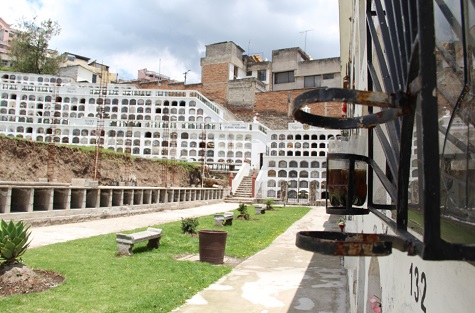 Every November 2, cemeteries are decorated with flowers, freshly painted crosses, pictures and cards to celebrate the Day of the Dead in Quito.
 The preparation of these dishes also serve as a reason for the entire family to get together. Colada morada, one of the typical beverages for the Day of the Dead, is a drink of indigenous origin and one of the most traditional delicacies of Quito’s cuisine. Prepared with a base of black corn, blueberries, blackberries, pineapple, orange and other fruits and herbs, colada morada is accompanied by the traditional guagua de pan, sweet breads shaped into baby-like figures made with wheat flour and, in some places, with cornmeal from grains from the Ecuadorian Andes.